On our wedding night, my husband smiled while holding a leather-bound rulebook and a forged medical proxy. “From now on, you follow every rule I give you,” he said, convinced he had married a weak woman he could control without resistance. I calmly stepped out of my heels and raised my guard. What he never knew was that the frightened, ordinary girl he thought he had married had never been real.
The Mask Slipped
The first moment of warning came before Graham had even taken off his wedding jacket. I looked at the rulebook he set beside our champagne, then at the leather strap he held in his hand, and realized the man I had loved for two years had only been wearing a mask.
He smiled as if my silence meant terror.
“Rule one: you never question me. Rule two: you ask permission before leaving this penthouse. Rule three: your salary goes straight into my account.”
The bedroom still smelled like roses from the reception. My white gown spilled around my feet, glittering and expensive, chosen by his mother because she said my taste was “too ordinary” for the Whitaker family.
I raised my eyes.
“And if I refuse?”
Graham’s smile turned sharp.
“You won’t.”
He tapped the strap against his palm, then reached out and tore apart my late mother’s antique veil — just to demonstrate his power.
But hidden behind his rulebook were documents far more dangerous than a leather strap: a forged confession for a massive corporate embezzlement, and a Medical Power of Attorney.
He didn’t only want obedience. He wanted a perfect scapegoat — a woman he could legally use to take the fall the moment she became inconvenient.
The Family Behind Him
His mother, Vivian Whitaker, had been preparing the ground for months. She dismissed my quiet voice, called me provincial, and kept reminding me that Graham’s family owned half the city. At dinner once, she laughed, “A woman like Emma should be grateful we allow her to sit at our table.”
I had smiled then.
Just like I smiled now.
Graham mistook calmness for surrender. Most controlling men did.
When he stepped toward me with the strap raised, I didn’t shrink away. I used my training to defend myself, disarm him, and bring him firmly down to the marble floor without leaving a mark on his face. Within seconds, he was restrained and breathing hard, unable to move.
“Rule one,” I whispered, holding the position. “Never trap a woman whose past you never bothered to learn.”
My first-degree black belt in Brazilian Jiu-Jitsu was only the first secret he had failed to notice. He thought I was a mid-level payroll clerk. He had no idea what was hidden inside the diamond necklace he had forced around my throat — or what I had been quietly transmitting.
Then the private elevator chimed. Vivian arrived — not with family lawyers, but with a private psychiatrist holding a syringe of sedatives, certain they were coming to subdue a broken, disobedient bride.
They thought they were walking into a cage. They didn’t realize they were walking into my operation.
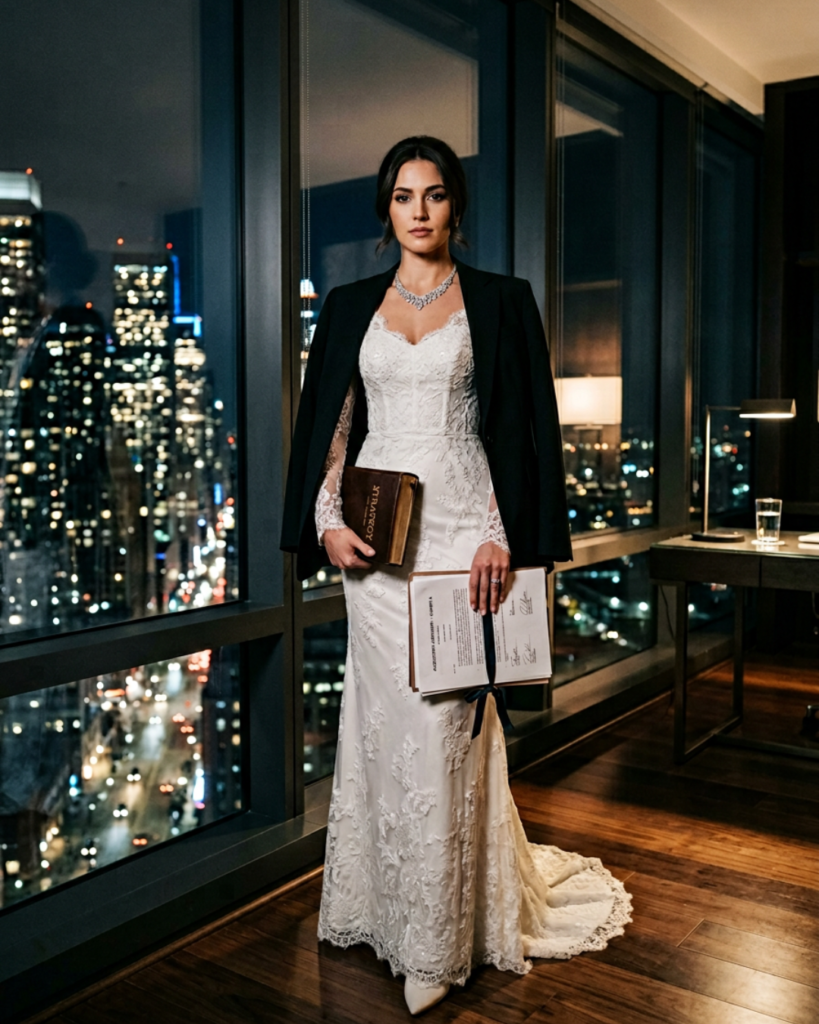
The Necklace That Heard Everything
The diamond necklace had been chosen by Graham’s jeweler and clasped around my neck by his mother three hours before the ceremony, in the bridal suite, while Vivian described it as a “family heirloom.” It was not an heirloom. But it did contain something — a miniaturized audio and location transmitter no larger than a small button, installed by the forensic technology division of the agency I had worked for since I was twenty-four.
My name was not Emma Clarke, payroll clerk.
That identity had been constructed eighteen months earlier when a financial crimes unit identified Graham Whitaker as the central figure in a corporate fraud network that had displaced the pensions of over three thousand retired workers across five states. The case required someone close enough to gather the documents that no subpoena had yet reached. Someone Graham would trust. Someone he would underestimate completely.
They selected me for the assignment because of my background in financial forensics and because my supervisor said, with characteristic understatement, that I was the most patient operative she had ever worked with.
Nineteen months of patience. The forged documents he had prepared to use against me — the embezzlement confession, the medical proxy — had been photographed by the necklace’s transmitter the moment he placed them on the bed. Every word spoken in that penthouse since the elevator doors had closed had been recorded. The rulebook. The threats. The torn veil. All of it transmitted in real time to a surveillance team parked two blocks from the building.
When Vivian stepped out of the elevator with the psychiatrist, she found her son sitting upright on the marble floor with one hand pressed to his wrist and an expression she had never seen on his face — the particular look of a man who has just understood that something he believed was entirely within his control was not within his control at all.
I was standing with my back to the window, still in my wedding gown, my heels beside me on the floor. I looked at Vivian. Then at the psychiatrist and the syringe. Then I said one sentence.
“You should know that everything said and done in this room tonight has been recorded and transmitted. The team outside has been listening since the elevator closed.”
Vivian looked at the necklace. Then at me. Then at her son on the floor.
The psychiatrist set the syringe on the side table and took two careful steps backward.
The Arrival
The penthouse door opened sixty seconds later. Four federal agents entered, led by my supervisor, who looked briefly at my wedding gown, at Graham on the floor, and at the torn veil in the corner. She did not comment on any of it. She simply handed me a jacket — my jacket, dark and professional — and said, “Well done. Let’s finish this.”
Graham was taken into custody that night. Vivian was detained for questioning within the hour — her coordination with the psychiatrist, documented by the transmitter, was sufficient to hold her pending formal charges. The forged documents Graham had prepared to use against me became evidence against him. The real corporate fraud documents — the ones I had spent nineteen months carefully accumulating through Graham’s own filing systems, his private communications, his off-record accounts — were submitted to federal prosecutors the following morning.
The case took eleven months to try. The result was thorough. The three thousand retired workers whose pensions had been displaced began receiving restitution payments the following year.
On the night it concluded, my supervisor sent me a message: The family of the lead pension victim called today. They wanted us to pass on their thanks to whoever was responsible. I told them it was a team effort. It was. But most of it was you.
What I Kept
I kept the necklace. Not out of sentiment — it had served its purpose. But because it was, technically, a piece of equipment that had performed exactly as designed, and I had a habit of keeping things that worked.
My mother’s veil, Graham had destroyed. That was the only thing in the penthouse that night that had actually been mine — irreplaceable, brought from home, worn because it had belonged to her. I did not forgive him for that specifically. I did not particularly try.
Some losses are simply losses. They do not require a lesson. They only require acknowledgment — that something real was taken, by someone who believed they had the right to take it, and that the belief did not make it true. He had believed many things about me that were not true. The ordinary girl. The weak woman. The frightened bride he had backed into a corner. None of them existed. They had never existed. They were simply the version of me he had needed in order to feel powerful — and the version I had allowed him to see, for nineteen months, because I was patient, and because patience, properly applied, is almost always enough.
The Lesson
The most dangerous assumption a controlling person makes is that they know who they are dealing with. They build an entire architecture of power on a version of the other person that they have constructed from their own need — the weak one, the frightened one, the ordinary one who should be grateful. When that version turns out to be a performance, the architecture has no foundation.
Patience is not passivity. Nineteen months of gathering evidence, of being underestimated, of watching and waiting and staying completely still, is not weakness. It is the kind of discipline that produces outcomes no single moment of confrontation ever could.
Three thousand retired workers received restitution because one woman was willing to be underestimated long enough to finish what needed finishing. That is the real story underneath the wedding gown and the marble floor and the rulebook. Justice, built slowly, by someone who never once needed the other person to know how dangerous she was.
She stepped out of her heels and raised her guard. He never saw it coming. He never had a chance to.
Advice
Controlling behavior does not begin on a wedding night. It builds over months and years through patterns — dismissals of your judgment, redefinitions of your identity, quiet reductions of your independence until you forget what the original version of yourself looked like. If someone in your life is consistently telling you who you are in ways that feel like subtraction rather than addition, pay attention to that.
A forged document, a medical proxy, a rulebook beside champagne — these are not the beginning of control. They are the moment control decides it no longer needs to hide. Everything that came before was the real architecture. Learn to recognize the early structure, not just the moment it becomes undeniable.
And if you are ever in a situation where someone believes they have completely defined who you are — remember that their belief does not make it true. You are under no obligation to be the version of yourself someone else required in order to feel powerful.
If this story resonated with you, share it with someone who needs to remember that control is not love, and underestimating a patient woman is a dangerous mistake.