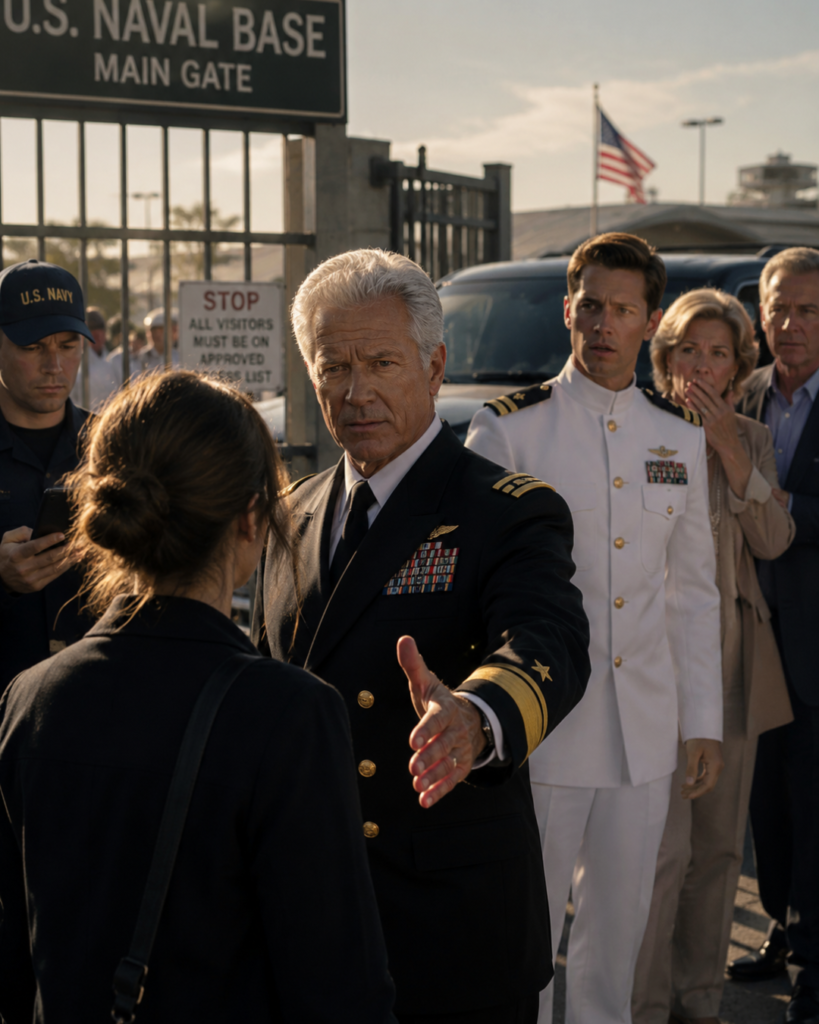
MY BROTHER WAS PROMOTED TO COMMANDER—AND I GOT STOPPED AT THE NAVY GATE LIKE A RANDOM STRANGER. THE PETTY OFFICER KEPT TAPPING HIS TABLET, THEN SAID, “SORRY, MA’AM… YOU’RE NOT ON COMMANDER MARCUS CARTWRIGHT’S LIST,” WHILE MY PARENTS WALKED RIGHT PAST ME SMILING LIKE THEY’D JUST ERASED ME AGAIN. THEN MARCUS STROLLED IN, PERFECT IN HIS WHITE UNIFORM, AND MURMURED, “LEAH FORGOT TO RSVP… SOME PEOPLE NEVER LEARN THE CHAIN OF COMMAND.” I JUST STEPPED INTO THE SHADOWS—UNTIL A BLACK GOVERNMENT SUV ROLLED UP, A STEEL-HAIRED ADMIRAL STEPPED OUT, AND SAID ONE SENTENCE THAT MADE EVERY HEAD TURN: “STAND DOWN… SHE’S NOT ON YOUR LIST BECAUSE HER CLEARANCE OUTRANKS YOURS.” THEN HE LOOKED STRAIGHT AT ME, RAISED HIS HAND… AND CALLED ME BY A TITLE MY FAMILY HAD NEVER ONCE SPOKEN OUT LOUD…
The sun was already bright enough to make the white paint on the security gate look hostile.
It reflected off the metal bars and the glass of the guard booth and the polished shoes of the guests drifting past me in slow, celebratory waves. Someone’s toddler waved a tiny flag hard enough to make it whip the air. A retired chief in dress blues adjusted his medals with a hand that trembled slightly—age, pride, both. A woman in a navy sundress laughed into her phone as if the day were a picnic and not a ceremony meant to reshape someone’s life.
I stood still on the wrong side of the line, my coat buttoned, the strap of my bag anchored across my shoulder, and watched the gate swallow everyone who belonged.
The petty officer in charge tapped furiously on his tablet, squinting beneath the Virginia sun. His jaw tightened the way it does when someone is trying to fix a problem in front of a stranger without admitting there’s a problem.
He wouldn’t find me.
Because I wasn’t there.
Not on the list. Not on the roster of people allowed to witness Commander Marcus Cartwright’s promotion to lead the Atlantic Strike Division. Not on the same page of the day that had been built around my brother’s name.
“Sorry, ma’am,” he said with a practiced tone that sounded kind but landed like a door closing. “You’re not on the guest list for Commander Marcus Cartwright.”
I didn’t flinch. I didn’t argue. I simply adjusted the strap of my coat and nodded once, the same small nod I’d learned to give since childhood—one that meant I understood the rules even when the rules were designed to exclude me.
Behind him, the gates to the Grand Naval Parade Grounds opened wide, letting in a sea of guests: retired officers in medals, families holding flags, current service members with spouses in pastel dresses and children in miniature uniforms. And among them, my own parents—smiling like nothing was wrong, like they hadn’t just erased me again.
My mother moved with her usual polished posture, cream blazer crisp, pearls catching the sun. She laughed at something my father said, her hand resting lightly on his forearm in that perfect photo-ready way she’d mastered decades ago. My father—Captain Thomas Cartwright, retired—walked tall as if he still owned a quarterdeck, his old uniform pressed so sharply it could cut.
They didn’t look toward the gate.
They didn’t look toward me.
They walked through the opening without hesitation as if the world had never forced them to choose between children.
Then Marcus arrived.
White dress uniform. Impeccable smile. Broad shoulders. Natural command posture like he’d been molded for ceremonies. The family jewel. The recruitment poster son. The man who could turn a crowd into applause with nothing more than the angle of his chin.
He strode toward the entrance with Lauren at his side—perfect hair, perfect dress, perfect timing. He didn’t slow when he reached the gate. He didn’t glance toward the guest list. He didn’t look like someone worried about who might be missing.
He glanced at me only long enough to murmur to his wife, just loud enough for me to hear:
“Leah forgot to RSVP. Some people never learn the chain of command.”
I almost laughed.
Not because it was funny.
Because I had followed the chain of command far longer than any of them knew.
I stepped aside, let the crowd swallow them, and stood in the shadow of the stone gate, invisible again. The petty officer hesitated, his face pulling into something that might have been apology.
“Ma’am,” he tried, offering me a clipboard like a lifeline. “Maybe… maybe if you’re checked in under another name—”
“That won’t be necessary,” I said softly.
And that was the moment the black government SUV rolled to a stop beside us.
It didn’t rush. It didn’t need to. It moved like authority—slow, inevitable, certain that the world would make room. The engine idled with a quiet hum that sounded expensive even if you didn’t know cars.
The tinted window lowered with deliberate finality.
A man inside gave the young sailor a nod.
“Stand down, Ensign,” he said.
The petty officer straightened instinctively, confusion flickering. “Sir, I—”
“She’s not on your list,” the man continued, voice firm but not unkind, “because her clearance outranks yours.”
Then he stepped out.
Admiral Rayburn.
Steel hair, sharp eyes, the kind of presence that didn’t demand attention because it automatically received it. The kind of man who could quiet entire rooms with a single look and never raise his voice once.
He didn’t glance at the tablet. He didn’t need to.
He looked directly at me and extended his hand—not in greeting, but in respect.
“Rear Admiral Cartwright,” he said, voice low and level.
The title landed in the air like a cannon shot wrapped in silk.
“We were starting to think you’d skip your brother’s big day.”
For a moment, I forgot how to breathe.
Because Admiral Rayburn had just said my name and rank loud enough for the cluster of guests near the entrance to hear.
And they did.
Heads turned. Conversations stopped mid-sentence. A woman’s laugh cut off as if someone had snapped her audio cable. The petty officer who’d been tapping at his tablet went pale. His hand twitched around the clipboard and then dropped it entirely.
“Admiral,” he stammered, “I— I wasn’t informed—”
“You weren’t supposed to be,” Rayburn said.
His voice held no cruelty, only reality.
“Proceed.”
He turned to me and gestured forward like the gate belonged to us.
“Shall we?”
I nodded once and unfastened my coat.
The cool spring air brushed against the deep navy of my formal uniform. Twin stars on each shoulder caught the sunlight and threw it back at the world. I didn’t flinch. I let the fabric fall just enough that the insignia could be seen, unmistakable.
A gasp rippled through the front of the crowd, not loud, but real.
Rayburn fell into step beside me.
And together we crossed the threshold.
On the other side of the gate, it felt like stepping onto a stage.
Rows of crisp white chairs flanked a polished walkway. Brass glinted near the podium. Dignitaries clustered in tight groups. Retired officers stood tall with spouses holding their arms like they were still supporting the weight of decades. Photographers lifted cameras on instinct and then lowered them just as fast when they saw the stars on my shoulders.
Not Marcus’s stars.
Mine.
I felt the weight of my parents’ gaze before I saw them.
My mother—Eleanor Cartwright—blinked twice, her smile stuttering. Her posture stiffened like someone had pulled a string up her spine. My father squinted as if the brightness had suddenly turned into illusion. He tilted his head slightly, the way he did when he suspected a trick.
Then I saw Marcus.
He was near the stage laughing with two younger officers, playing the role he’d been training for since childhood. He looked like someone who’d prepared for a spotlight his whole life and was just now realizing it might be pulled in another direction.
Our eyes met.
His jaw tensed. His smile faltered.
He leaned toward Lauren, whispering something I couldn’t hear. Her manicured brows lifted as she followed his gaze.
I watched her lips part as she realized who I was.
Not Leah, the forgotten sister who “never learned the chain of command.”
Rear Admiral Leah Cartwright, Director of Naval Cyber Intelligence.
Rayburn leaned slightly toward me. “Front row, left,” he said. “Your seat’s reserved. Follow me.”
I didn’t hesitate.
As we walked, officers shifted aside—some saluting, some simply stepping out of the way. I caught murmurs as we passed, short clipped phrases that told me exactly how the room was recalculating.
“She outranks half the board.”
“Did you know she was coming?”
“Since when—?”
I walked with shoulders squared, each step measured not out of pride, but precision. I’d spent a decade moving through corridors where your posture was part of your language. You didn’t slouch in secure facilities. You didn’t fidget during briefings. You didn’t look uncertain unless you wanted uncertainty to be weaponized against you.
When we reached the front row, a junior lieutenant stood and snapped to attention, eyes wide. He hadn’t expected anyone outranking Rear Admiral Fletcher to sit there.
Rayburn nodded once. The young officer stepped aside like the air had moved him.
I sat.
Not in defiance.
Not in rebellion.
In earned authority.
And as I settled into the seat—shoulders back, eyes forward—the band struck the first note of the national anthem.
I didn’t look back.
Because for the first time in my life, they would have to look at me.
They would have to see what they’d spent decades pretending wasn’t there.
The ceremony unfolded with the precise rhythm of a naval chronograph. Opening remarks. Flag presentation. Commendations. A series of speeches full of polished phrases like “service,” “honor,” “legacy.”
I heard it all, but not all of it registered.
My attention drifted not to the podium, but to the currents in the crowd—the subtle shifts, the tension tightening and loosening like rope. From the corner of my eye, I caught Marcus glancing over—not often, just enough to confirm I was still there.
His posture stayed perfect, but his jaw flexed every few minutes.
A micro-adjustment he couldn’t control.
A childhood tell.
He always clenched his teeth when something didn’t go according to script.
And this was never in the script.
When the time came, his name rang through the courtyard like a bell.
“Commander Marcus Cartwright—front and center.”
Applause rose: proud, polite, practiced. Marcus stood, uniform sharp, shoulders back, every inch the officer he’d been raised to be. He marched with textbook precision, accepted his commendation from Vice Admiral Nash, shook hands, saluted.
All perfect.
Then came the speech.
Marcus stepped to the podium, cleared his throat, smiled.
Not quite as easily as he had earlier.
“I’m honored,” he began, “to accept this promotion on behalf of every mentor, peer, and leader who believed in the chain of command and the responsibility it carries.”
Applause.
He thanked his unit. His superiors. His peers.
Then his tone softened into the family segment, as expected.
“And of course,” he said, “I owe everything to the people who shaped me long before the Navy ever did.”
My mother’s spine straightened. My father lifted his chin.
Marcus thanked Lauren, his wife, for standing by him through deployments. Light laughter. A few nods.
Then he thanked my mother.
“My mother, Eleanor Cartwright,” he said, “who taught me that discipline and grace are not opposites, but companions.”
My mother smiled, composed again, as if the universe had returned to its proper alignment.
Marcus thanked my father.
“And my father, Captain Thomas Cartwright,” he continued, “whose leadership taught me the difference between power and purpose.”
My father’s mouth tightened in pride.
Marcus paused then, a fraction longer than he should have.
Silence crept in.
He looked up and for the first time his eyes locked onto mine.
Less than a second.
But in that flicker, I saw his confusion.
The rewiring.
The recalculation.
Then he looked away, swallowed hard, and continued.
“For everyone who has served before me and alongside me,” he said, forcing the words out with an audible shift, “thank you for your service, your example, and your sacrifice.”
There it was.
No mention of me.
Not a name. Not a title.
Just that brittle silence again, dressed in ceremonial ribbons.
It should have hurt.
It might have once.
But today it didn’t, not the way it would have when I was twelve and still begging for a place at the table.
Because my name had already arrived long before he opened his mouth.
The crowd applauded as Marcus stepped down.
It was beautiful applause.
But it wasn’t just for him anymore.
I could feel it in the way the air had changed—the way whispers traveled, the way eyes kept cutting toward me, the way my parents sat too still, as if movement might confirm the reality they were trying to deny.
After the ceremony, the crowd spilled onto the reception lawn like champagne foam—bright, noisy, oversweet. Families posed in clusters. Photographers snapped away. Brass plates clinked softly on linen-covered tables.
I remained near the perimeter.
Not hiding.
Observing.
Old habit.
Besides, I was waiting.
I knew he’d come.
And he did.
Marcus approached alone.
No fanfare. No camera-ready grin. Just a man walking toward a question he didn’t know how to form.
He stopped two steps away. His face was tight like someone realizing he’d been reading the wrong script for years.
“Admiral Cartwright,” he said.
I returned his nod. “Commander.”
He tried to smile. It faltered halfway.
“I didn’t know,” he said quietly, but edged. “No one told me you were still in service.”
I held his gaze.
“You never asked,” I said.
His jaw clenched again, then released.
“I thought you left after Annapolis,” he admitted. “You… you never said anything.”
“You never asked,” I repeated, softer now—not to hurt him, but because truth is truth no matter how gently you deliver it.
Marcus looked away, hands sliding into the pockets of his dress blues.
“You could’ve told us,” he muttered.
“Would it have mattered?” I asked.
He didn’t answer.
I took a breath.
Not angry.
Clear.
“You had a version of me that worked for you,” I said. “Quiet civilian background. Easy to manage. Easy to ignore.”
Marcus blinked, his throat working as if he were trying to swallow words he’d never learned to speak.
“I let you keep it,” I continued. “That was my mistake.”
His mouth opened like he was going to argue, but nothing came. Instead, he asked the first honest question he’d ever asked me as an adult.
“Why today?” he said. “Why now?”
I looked past him toward the flag still fluttering above the stage, snapping in the wind.
“Because it was time,” I said. “Because sometimes the truth doesn’t need permission to arrive.”
Marcus’s lips parted again, and this time his question came out smaller—fragile, almost reluctant.
“That operation in the Gulf,” he said. “Last year. My carrier was rerouted mid-mission. Intel came in… less than six minutes before deployment.”
My chest tightened, not with pride, but with memory. A windowless room. A blinking map. A decision made with seconds left.
“You were…?” Marcus asked, voice barely audible over the reception noise.
“Yes,” I said simply. “That was me.”
Marcus exhaled slowly. His eyes dropped to the ground, then lifted again.
“You saved lives,” he said.
“I did my job,” I replied.
A beat of silence passed between us, heavier than the years ever were.
Then he said the only thing that mattered.
“Thank you.”
I nodded once.
For a moment, neither of us moved.
Marcus wasn’t my enemy. Not really. He was just raised in the same mirror I had shattered my way out of.
He stepped back and offered a sharp salute.
This time the formality wasn’t performative.
It was respect.
I returned it without hesitation.
Then I turned and walked away—not triumphant, not wounded, just steady.
Because the version of me they ignored had just walked into daylight, and I wasn’t going back.
If you want to understand why that moment mattered so much—why being denied at the gate and then stepping through it with an admiral at my side felt like the end of something and the beginning of something else—you have to understand what it’s like to grow up as the child no one decorates.
When I was eight, my father taught Marcus how to shine his boots until the leather looked like water. We sat on the back steps, the air thick with summer humidity, and the polish tin sat between us like an offering.
Marcus scrubbed in small circles, his tongue caught between his teeth in concentration. My father watched him with that patient pride he rarely gave away, correcting his grip, nodding approvingly.
I sat one step above them, holding the polish tin, hoping he’d ask me to try.
He never did.
At twelve, I won the regional science fair. My project was on sonar detection patterns—how certain waveforms could be interpreted to track movement through noise. I’d spent weeks building it, staying up past midnight, running tests in my bedroom with a cheap speaker and a homemade sensor.
I got a certificate, a ribbon, and a single nod from my homeroom teacher that felt like sunlight.
At dinner that night, my mother barely looked up.
Marcus had passed his ROC exam with top marks.
He got a cake.
I got silence.
That was how it always was in our house.
I wasn’t unloved. Not exactly.
I was undecorated.
Too quiet. Too cerebral. Too hard to photograph.
Marcus, on the other hand, was the kind of child you could put on a recruitment poster before he turned fifteen. Broad shoulders, confident grin, natural posture—like he’d been born standing at attention.
I learned early not to compete.
I stepped out of frame.
It wasn’t a dramatic decision. It wasn’t martyrdom. It was survival math. If you stop asking, you stop getting hurt when you don’t receive.
So I became useful in quiet ways.
I cleaned without being asked. I brought my mother water when she hosted parties. I learned to read the room the way my father read weather patterns. I learned to anticipate needs before they were spoken because spoken needs were inconvenient.
And when Marcus needed something—help studying, someone to cover for him when he snuck out, a ride—he came to me. Not because he respected me, but because I was reliable.
I served.
That’s the word I keep coming back to.
Even before the Navy, I served.
I graduated from Annapolis at twenty-three.
Quietly. No fireworks. No dramatic speech. My father shook my hand and said, “Good,” like it was expected. My mother took photos. Marcus clapped me on the back and said, “You did it,” like I’d finished a marathon he didn’t plan to run.
Everyone assumed I would go command track.
That I’d chase the visible ranks the way Marcus did.
But command is theatre. Leadership is often performance. And I’d spent my whole life as a background character watching how performances can hide rot.
So I went into intelligence.
Not flashy.
Necessary.
I specialized in asymmetric warfare, counter-infiltration modeling, and—ironically—narrative suppression. The quiet work that keeps loud work possible. The kind of work that never gets mentioned in speeches, because mentioning it would ruin it.
While Marcus climbed visible ranks, I disappeared behind unmarked doors and classified seals.
I spent my twenties in windowless rooms where the air was always cold and the clocks were always accurate. I learned how to read patterns in chaos, how to pull signal from noise, how to predict what an adversary would do before they knew they were doing it.
I learned that the most dangerous thing in the world isn’t a weapon.
It’s a story people want to believe.
And I learned that my family wanted to believe a story about me too.
The story where Leah was the quiet sister who probably left the service because she “couldn’t handle it.”
That was the part that stung the most.
Not that they ignored me—ignoring me was normal.
But that they assumed I’d quit.
Not once in ten years did my father ask where I was stationed. Not once did Marcus reach out after he heard I transferred to the Pentagon. Not once did my mother ask what I did, what I carried, what kind of rooms I worked in.
When the family spoke of the Cartwright legacy, they didn’t mean me.
They meant Marcus.
The son. The commander.
And yet, when orders needed rewriting, when a task force went dark in the Gulf, when command centers scrambled and clocks ran out, the calls didn’t go to Marcus.
They went to me.
No one at the parade grounds knew that.
Not yet.
So I stood by the gate, coat buttoned, silver bars hidden beneath civilian gray, and watched my family walk past me like I was just another spectator.
Until Admiral Rayburn changed the story out loud.
Three days after the promotion ceremony, I was back in Washington.
The air inside the Pentagon always felt colder than it should—filtered, clinical, detached. I liked it that way. It made focus easier. Hierarchy here was concrete. Less personal. People didn’t ask where you came from.
They asked what you could carry.
Admiral Rayburn called me into a secure conference room.
No preamble. No smile.
Just a thick manila folder slid across the table with my name stamped in bold.
“Cartwright,” he said.
“They want you to lead the Pacific Hybrid Operations Unit.”
I raised an eyebrow, careful not to let surprise look like weakness. “I thought they were grooming someone else.”
“They were,” Rayburn said, voice dry. “Until last week.”
I opened the folder.
Charts. Satellite overlays. Strategic gaps between joint forces. Threat matrices layered like a map of storms.
This wasn’t just intel anymore.
It was operations. Cyber counterpunch. Hybrid strategy. Doctrine shaping.
“Congratulations,” Rayburn added. “You’re the new blueprint.”
I leaned back slightly, the leather chair creaking beneath my shoulders.
“What about JSC?” I asked. “I thought I was earmarked for strategic command integration.”
Rayburn’s mouth twitched into something like a smirk. “You were.”
He tapped the folder.
“Then someone showed them what happens when you show up at a parade and reset a family narrative in real time.”
I stared at the documents. My thumb brushed the edge of the page, grounding me.
“This comes with resistance,” I said.
“All revolutions do,” Rayburn replied.
I closed the folder and looked him in the eye.
“I’m not here for a revolution,” I said.
Rayburn’s eyes sharpened. “You’re having one anyway,” he replied. “You just do it quieter than most.”
That night, I returned to my apartment overlooking the river. Lights shimmered on the water. Far below, silhouettes of ships waited in the shipyard like sleeping giants. I poured myself a glass of water.
No champagne.
No phone call home.
I stood at the window and whispered the title out loud, just once, to hear how it sounded in air.
“Commander of Pacific Hybrid Operations.”
It didn’t feel heavy.
It felt earned.
And that’s when a message came in from an encrypted line I hadn’t used in over a year.
Marcus.
Two words, simple and direct.
Can we meet?
We met the next morning in a quiet café in Arlington, civilian clothes, no insignia, no crowd. Marcus arrived first. No swagger. No recruitment-poster grin.
Just a man who looked like he’d started seeing things differently.
“They offered me a liaison role,” he said when I sat down. “Under your command.”
I stirred my coffee. “Are you here to decline it?”
“No,” Marcus said. “I asked for it.”
That caught me off guard.
He held my gaze, steady. “I want to be where the right decisions are being made,” he said. “Where I can learn.”
I studied him for a long moment. Not searching for sincerity like a romantic would.
Searching for pattern like an analyst.
“You’re sure you’re okay working under your younger sister?” I asked.
Marcus smiled—small, sheepish, but real.
“I’m not sure I deserve the spot,” he admitted. “But I know I’ll be proud to serve in your chain of command.”
Something in my chest loosened—not forgiveness, not yet, but recognition of effort.
I nodded once. “Then let’s get to work.”
And just like that, we stopped being a competition.
We became a command.
A week later, my mother invited me to dinner.
No pretense. No occasion.
Just a text: Sunday at 6. Just us. Marcus will be here.
I stared at the screen longer than I meant to.
Not because I didn’t know what to say.
Because for the first time, I didn’t need the invitation.
I could ignore it and nothing in my life would collapse.
That kind of freedom is disorienting.
I accepted.
When I pulled into the driveway that Sunday, the house looked the same: brick siding, clean hedges, flagpole standing perfectly straight by the porch like it was still at attention.
But something was different.
Maybe it was me.
Marcus answered the door. No uniform. Sleeves rolled to his elbows. He was setting the table like it was something he’d always done and not something he’d once assumed women handled.
“You’re on time,” he said.
“You’re early,” I replied.
We both smiled—soft, simple, unfamiliar.
Inside, the smell of roast chicken and rosemary floated through the air. My mother moved between the kitchen and dining room like she was performing a familiar dance, but this time she wasn’t rushing to correct, wasn’t snapping at details.
She just… let it be.
My father stood at the head of the table when I entered.
He didn’t speak at first, just nodded.
Then, after a pause, he reached out his hand—not stiffly, not ceremonially, but like he meant it.
“Welcome home, Admiral,” he said.
The words settled in the air like warm ash—quiet, but impossible to ignore.
Dinner was steady.
We talked logistics. Deployment updates. Joint drills. Marcus asked questions about Pacific strategy that weren’t performative. My mother asked questions too—not to sound informed, but because she was curious.
No one mentioned the parade.
No one needed to.
Over dessert—a simple peach cobbler—my father set down his fork and cleared his throat. It was the kind of sound that once silenced rooms.
“You’ll be the highest-ranking Cartwright in four generations,” he said.
I didn’t respond immediately.
I didn’t need to.
He continued, voice lower now, stripped of authority and edged with something like humility.
“You didn’t inherit that,” he said. “You built it.”
He swallowed.
“And I was wrong not to see it.”
My mother reached across the table and touched my hand gently.
“We were all wrong,” she said softly. “But we see it now.”
I looked at her—really looked—and for the first time there was no performance behind her eyes.
Just clarity.
Across the table, Marcus raised his glass.
“To the sister who rewrote the standard,” he said.
And for once, no one corrected him.
We finished dinner without ceremony. Plates cleared. Lights dimmed. For a long moment, we just sat—not as a family trying to fix the past, but as people acknowledging a truth that had lived too long in the dark.
When I stood to leave, my father clapped a hand on my shoulder.
“You made the name mean something again,” he said.
I looked him in the eye.
“No,” I replied. “I gave it something it never had.”
He didn’t argue. He just nodded.
One month after the promotion, I stood before my new office at the Pentagon.
The plaque on the door read: Vice Admiral Leah Cartwright, Director of Pacific Hybrid Operations.
Simple. Understated.
But it was the culmination of every moment I had once lived in silence.
Inside, the air felt different. Advisers spoke slower when I entered. Senior officers adjusted posture not from protocol, but instinct. My name no longer traveled through back channels. It led meetings. It signed directives. It reshaped how command itself operated.
Then the White House summoned me.
The President—herself a former Navy veteran—asked for a direct briefing.
Indo-Pacific joint force posture. Escalation modeling. Cyber breach containment.
I delivered it in thirty-four minutes.
No slides.
No fluff.
Just clarity.
When I finished, the room was still—the kind of still that doesn’t question, that waits.
The Secretary of Defense spoke first.
“Vice Admiral Cartwright,” he said, “this isn’t just operational foresight. It’s doctrine-level thinking.”
The Chairman of the Joint Chiefs added, “We’ve had admirals before, but never one who rewrote the playbook mid-game.”
I gave a small nod.
No false humility.
No performance.
Just acknowledgement.
Because I’d earned it.
That night, I walked alone along the Navy Yard. Water quiet. Ship silhouettes floating in the harbor like sentinels that watched and remembered. My phone buzzed.
Marcus.
A photo appeared.
My image on a new recruitment banner stationed outside our old high school: full uniform, eyes forward, caption in clean bold font.
Earned, not inherited.
Then his message followed.
They’re quoting you now, Leah. Everywhere. You’re not just a story. You’re a signal.
I stood there a long time watching the reflection of ship lights shimmer across the pavement.
Then I replied:
Then let’s make sure the signal leads somewhere worth following.
Because in the end, I hadn’t fought for a seat at their table.
I had built a new one.
And I left the door open—not for them, but for whoever came next who’d been told they were too quiet, too undecorated, too hard to photograph to matter.
I knew better now.
Quiet doesn’t mean absent.
It means listening.
And listening, when sharpened by years of being ignored, becomes power.
