The morning after my mother’s funeral, I came downstairs to find my brother Marcus already at the kitchen table with a legal pad, a ballpoint pen, and the cold efficiency of a man who had been waiting for this moment for years.
He did not look up when I walked in. He was circling things on a handwritten list. The house. The savings account. The blue Buick in the garage. The jewelry box upstairs. The quilts. The cast iron pans. He had itemized my mother’s entire life while her funeral flowers were still fresh on the mantel.
“We should talk about the estate.”
— Marcus, without looking up
Not good morning. Not how did you sleep. Not even the bare, obligatory acknowledgment that we had both buried our mother the day before.
I sat down across from him. I was still wearing the black dress from yesterday because I had fallen asleep in it on the couch, too exhausted to change. My eyes were swollen. My throat hurt from the kind of crying that does not produce sound.
“Marcus,” I said. “She died yesterday.”
“I know when she died. I was there.”
He had been there, in a technical sense. He had arrived forty minutes before the service with his wife Diane and their two sons, shook hands with people he barely knew, and left before the last car cleared the cemetery. I had stayed until the grave was finished. I had thanked the pastor. I had carried the leftover casseroles to the neighbors. I had driven back to her house alone and sat in the parking lot for twenty minutes before I could make my legs move.
“I’d like to wait at least a few days before we discuss any of this,” I said.
“I have to get back to work. Diane needs to know about the school fund. The longer we wait, the messier this gets.”
— Marcus
The School Fund
The school fund. I had forgotten about the school fund. Five years ago, when my mother’s neighbor Mrs. Patton passed away, our mother had quietly taken a portion of her modest savings — money she had set aside over thirty years of working at the county clerk’s office — and put it into a restricted account at the community college. The fund paid for a scholarship every year for a first-generation student from our county. She had told almost no one. She had not named it after herself.
I had found out by accident when I drove her to the bank one afternoon and she had forgotten I was in the car when she talked to the teller.
Marcus had found out three months ago when he sat down with her finances to — as he put it — help her “get organized.” That was when the calls to me started. Did you know about the account? How much is in it? Who gave her permission?
“The scholarship fund is not part of the estate,” I said. “She set it up as a restricted charitable account. It doesn’t pass through probate.”
He circled something on his legal pad. “We’ll see what the attorney says.”
“I already know what the attorney will say.”
“How would you know that?”
“Because I helped her set it up.”
That was when Marcus finally looked at me.
The Years Between
Let me tell you what the years between my mother’s early retirement and her passing actually looked like, because Marcus’s version of those years bears no resemblance to mine.
In his version, he was a devoted son who called every Sunday and contributed financially when it mattered. In his version, he had offered to move her closer to him in Atlanta multiple times and she had simply chosen not to go. In his version, I had stayed in town not out of love or duty, but because I had nowhere better to be.
In my version: I drove her to treatment eleven times across two different rounds. I filled her prescriptions every month and organized them into labeled weekly containers because she got confused by the bottles. I called her every morning — not Sunday, every morning — because she was afraid to wake up alone and not know where the day was going. I took her to church when she was well enough, and sat with her on the porch reading the bulletin aloud when she was not. I slept on the pullout couch in the living room for six weeks during her last decline so she was never more than one room away from someone who loved her.
Marcus sent money twice. Both times in response to direct requests I had made when bills exceeded what I could absorb. Both times accompanied by a comment about “getting her affairs in order.”
He visited five times in four years. Three of those visits were over Christmas. He stayed at a hotel each time because the guest room was, he said, “uncomfortable.” My mother never said a word about it to him. She said one sentence about it to me, once, sitting on the edge of her bed putting on her slippers.
“He was always more comfortable somewhere else.”
— My mother
She did not say it with bitterness. She said it with the particular peace of someone who has accepted a thing completely and decided to love around it rather than through it.
I did not resent the work. I want to be honest about that. I would do every single bit of it again. But the morning after her funeral, sitting across from my brother and his legal pad, I felt the first cold edge of something that was not grief. It was clarity. The kind that arrives when performance finally ends and only the accounting remains.
The Will Reading
The attorney’s name was Gerald Whitmore. He had an office downtown that smelled of old carpet and coffee. Marcus arrived first and sat with his arms crossed. Diane sat beside him, already holding a small notebook. I sat on the opposite side of the table and kept my hands flat on my knees.
Gerald began with the standard language. The house, the savings account, the car. Split evenly between the two of us, which I had expected. Marcus uncrossed his arms slightly. Then Gerald turned to the next page.
“There is an additional personal bequest, listed separately. To my daughter, I leave the contents of the cedar chest in the upstairs hallway, my mother’s ring, and the handwritten letter kept in the envelope taped to the back of the kitchen clock.”
— Gerald, reading
Marcus straightened immediately. “What about the jewelry box?”
Gerald looked at the document. “The jewelry box is mentioned in the inventory of household contents and falls within the even split.”
“What’s in the cedar chest?”
“The will does not specify.”
Marcus turned to me. “Did you know about this?”
I shook my head. And that was true. I knew about the cedar chest. I had dusted it more times than I could count. I had sat beside it doing my mother’s physical therapy exercises with her in the narrow hallway. I did not know what was inside it. She had never offered to show me and I had never asked.
Gerald folded his hands. “There is one final item. Regarding the charitable scholarship account—”
“The restricted account is not part of this estate and passes directly to the community college foundation per the original documentation. No portion of it may be claimed, contested, or redirected by any heir.”
— Gerald
Marcus’s pen stopped moving. The room went quiet enough that I could hear the hum of the building’s ventilation.
“That money should have been part of the estate. She was not competent to make those decisions without family input.”
— Marcus
“She was entirely competent,” I said. “She was doing the crossword puzzle from the newspaper the week before she passed.”
“I’m talking about financial decisions.”
“So am I.”
Gerald cleared his throat. “The documentation establishing the account includes a signed cognitive evaluation and legal verification of capacity. It is airtight.”
Marcus stood up before Gerald finished. “I’ll need time to review this with my own counsel.”
“Of course,” Gerald said. He looked at me with the particular expression attorneys use when they want you to know they have seen this before and it will be fine.
The Cedar Chest
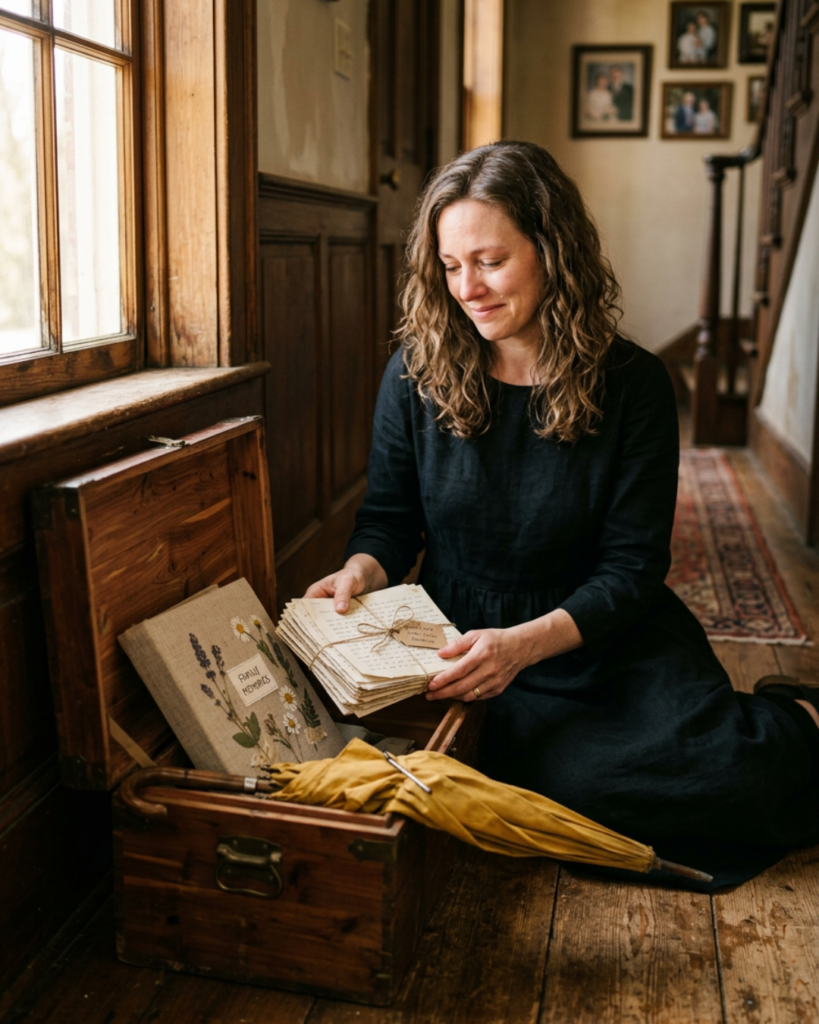
That evening, I drove back to the house alone. The key felt different in my hand now. I stood in the hallway for a moment before opening the cedar chest. The wood smelled of lavender and something older — cedar and old paper and time.
Inside were three things. A bundle of letters tied with kitchen twine. A small photograph album, handmade, its cover decorated with pressed flowers. And a rain-softened yellow umbrella with a broken spoke, folded carefully in a dry cleaner’s bag.
I sat down on the hallway floor and opened the photo album first. The first page made me catch my breath. It was photographs of me. Not official portraits. Candid pictures taken when I did not know anyone was watching. Me asleep in the chair beside her hospital bed. Me reading a book in her kitchen. Me helping her walk across the parking lot at the pharmacy, the two of us sharing that broken yellow umbrella in the rain, both of us laughing at something the camera could not record.
On the last page of the album, her handwriting.
“She was here. Every single time.”
— My mother’s handwriting
I sat on the hallway floor for a long time. The umbrella in my lap. The album open. The letters still tied.
When I finally opened the letter from behind the kitchen clock, it was one page. Her handwriting at the end was shakier than the beginning — she must have started it months before she finished it.
“You never asked me to notice you. You just showed up and kept showing up. I noticed anyway. The chest is yours because those are your years. No one can divide those.”
— My mother, from the letter behind the kitchen clock
I folded the letter carefully. Then I sat there a while longer, doing nothing, because sometimes the only appropriate response to being completely known by someone is to let the silence hold it.
What Marcus Did Next
He contested the scholarship fund. His attorney filed a motion claiming the account had been established while our mother was under “undue influence.” The name on the undue influence claim was mine.
I am not going to pretend this did not hurt. It did. Not because I was afraid of losing — Gerald had already told me the documentation was solid — but because Marcus had looked at everything I had done for our mother and decided the most useful version of it was as a weapon against her final wish.
The motion was dismissed within three weeks. The cognitive evaluation held. The legal structure of the charitable account held. The scholarship remained untouched.
Marcus called me the night the motion was dismissed. I answered. He did not apologize. He said:
“You should know I’m not going to just accept this.”
— Marcus
I thought about what to say for a long moment. I thought about the years. The mornings. The pharmacy runs. The chair beside the hospital bed. The broken umbrella. I thought about what my mother had written.
“You don’t have to accept it. You just have to live with the fact that she did it. She knew exactly what she was doing. She always did.”
— Me
He hung up.
We have not spoken since. I do not know if we will again. That grief is real too — different from losing my mother, smaller in some ways and stranger in others. Losing a parent is clean, in the end. It is the natural order of things. Losing a sibling is a different kind of fracture. It happens because of choices made while everyone is still alive and could have chosen differently.
The Scholarship
In the spring, I attended the scholarship ceremony at the community college. I sat in the back. I had not planned to go — I had found out about it by mail, a formal notice sent to next of kin from the foundation office.
The recipient was a young woman named Adriana. She was twenty-two. She was the first person in her family to attend college. When she accepted the scholarship, she said something I was not prepared for.
“I never met the woman who created this fund. But I have thought about her every single day. I think about what it means that a stranger saved up for thirty years so that someone she would never know could have a different life. She didn’t need recognition. She just needed to give.”
— Adriana
I did not stand up or introduce myself. I sat in the back row and pressed the photograph album against my chest and let her finish without interruption.
On the drive home, I thought about my mother sitting at the kitchen table thirty years ago, watching rain come down through the window, deciding quietly what she wanted her life to mean when it was over. She had not told her children. She had not told the neighbors. She had not put her name on the fund. She had just decided — with the same private certainty she brought to everything — and she had done it.
Marcus had called it something she was not competent to decide. He had called it lost money. He had filed a legal motion to stop it.
It had still happened. A twenty-two-year-old woman named Adriana was in college because of it.
I kept the broken umbrella. I did not fix it. It lives on the hook by my front door. When people ask, I tell them my mother and I used to share it in the rain when we were both too stubborn to go back inside for a better one. That makes people smile. It is also true.
What I do not usually tell them is the rest of it. The legal pad. The scholarship. The cedar chest. The motion that failed. The phone call that ended in silence. The brother I no longer know.
But I am telling you, because these things happen in ordinary families in ordinary houses and they are almost never discussed at funerals. Someone cooks the casseroles and drives to the pharmacy and sits in the chair at the hospital. Someone else shows up with a legal pad the morning after. And the person being buried — the one who understood everything quietly and loved people anyway — usually knew exactly what she was doing. She always did.
What I Learned
My mother did not leave me the house or the savings account alone. She left me the cedar chest — and inside it, the evidence that I had been seen. Not rewarded. Not compensated. Seen. There is a profound difference between the two. Marcus wanted compensation. What I received was recognition. And recognition, from the person whose opinion mattered most, turned out to be worth more than anything on a legal pad.
The scholarship survived because it was built correctly — quietly, legally, with documentation that no grief-fueled legal motion could undo. That is the practical lesson. But the deeper lesson is this: my mother spent thirty years building something that would outlast her without her name on it. She never asked whether Adriana would remember her. She did not need to be remembered. She needed to have done it. That is a rare and serious kind of integrity, and it is worth thinking about the next time you wonder whether the small, private, uncelebrated things you do actually matter.
Losing a parent is the natural order. Losing a sibling is different — it happens because of choices made while everyone is still alive. Marcus did not lose his sister because of the will. He lost her because of the legal pad the morning after the funeral, and every choice that led to that moment. The fracture was not created by the estate. The estate only revealed a fracture that had been there for years.
The broken umbrella stays by the door unfixed. That is not a failure of maintenance. That is a choice. Some things are kept as they are because what they mean is more important than what they do. She knew exactly what she was doing. She always did.
Advice
If you are the person who shows up — who drives to the pharmacy, who sleeps on the pullout couch, who calls every morning — please understand that what you are doing is real and it matters, even when nobody is counting. Especially when nobody is counting. The work of caring for someone is not diminished by the fact that a sibling did less. It stands on its own. You do not need permission to grieve fully or to protect the things your parent chose to do with their own life.
If an aging parent has wishes — charitable, personal, or otherwise — help them make those wishes legally solid. A cognitive evaluation, an attorney, a documented process. Not because you distrust them, but because the people who weren’t there will sometimes try to rewrite the story once the person is no longer alive to tell it themselves. Your parent’s decisions deserve the same protection as your parent.
If you are Marcus in this story — if you have been absent in the ways that matter and present only for the things that have a dollar value — this is a moment to be honest with yourself before it becomes a legal filing. The grief after losing a parent is disorienting. It can make people reach for control because everything else feels uncontrollable. But what looks like protecting the family is sometimes just protecting yourself from the discomfort of having done less. Those are different things. Know which one you’re doing.
And if you find a cedar chest: open it. Whatever is inside is the part of the story that was kept safe for you — not because it was the most valuable, but because it was the most true.
If this story touched you, share it with someone who needs to know that the quiet work of showing up is never wasted.