He didn’t raise his voice. He didn’t clear his throat. He didn’t look embarrassed saying something that absurd in the middle of my dining room. He just sat at table 7 with a glass of wine he hadn’t paid for, looked up at me with that old calm authority, and said:
“You’re going to sign over fifteen percent of this place to Tyler tonight. Before close.”
The Restaurant I Built Alone
It was a Tuesday in Austin, one of those warm evenings when the city looked polished from a distance and ragged up close. Inside Renn, the lighting was low, the playlist soft, the dining room just beginning to fill with the kind of customers who booked two weeks ahead because they wanted the braised short rib before it sold out. I had built that room with my own hands and every dollar I could scrape together. The wood on the walls came from a demolished farmhouse outside Waco. The brass letters over the entrance had cost more than I could comfortably afford, but I ordered them anyway because I needed to see my name there. Needed proof that after everything, something in this world belonged to me.
And then my family walked in and acted like it belonged to them too.
My father, Dean, believed volume and certainty were the same thing as truth. My mother, Elaine, had mastered the softer violence of selective memory. She could watch a thing happen and describe it later in a way that made you doubt yourself for remembering it accurately. Tyler was their golden exception to every rule. Charming, impulsive, irresponsible, and somehow always one misunderstanding away from deserving another chance. I was the difficult one. The one who asked questions. The one who remembered numbers. The one who noticed when stories changed.
The Debt That Wasn’t Mine
When I was nineteen, Tyler wanted to open a detailing business. Six months later it collapsed under unpaid invoices and equipment debt. Nobody talked about it after that. Tyler moved on. He always moved on. Five years later I pulled my credit report while applying for a small-business loan and found a debt I didn’t recognize. Thirty-two thousand dollars. The account had been opened in my name when I was nineteen. The address attached to it was my parents’ house.
I remember sitting in my car outside the bank with the air conditioning blasting at my face, trying to understand what I was reading. My hands were shaking so badly I had to lock my elbows just to keep the paper still. I called the lender first. Then my father. Then my mother. Then Tyler. My father didn’t deny it. Not exactly. “It was temporary,” he said, like that should have settled it. “We meant to fix it before it touched you.”
“You used my personal financial details.”
“Your brother was drowning.”
“So you pushed me under instead?”
My mother got on the phone. “Don’t be dramatic, Ren. We’re family. These things happen.” When I said I was going to the authorities, they stopped pretending. My father said I’d destroy Tyler’s life. My mother cried. Tyler called me selfish. By the end of the week, I had become the villain in the family story for objecting to financial fraud. Then they stopped taking my calls.
The silence after that was worse than the fight. For months I kept dialing. Birthdays. Holidays. Random Tuesdays. I left voicemails that got smaller and more careful over time. There were thirty-seven calls in total before I finally deleted the thread and stopped humiliating myself. I worked extra shifts, negotiated payment plans, sold my car, and paid off a debt that should never have existed.
The anger in me changed texture during those years. At first it was sharp and blazing. Then it became colder, heavier, almost useful. Something I could stack under myself like bricks. That’s how Renn was built. Brick by bitter brick.
The Investor Who Believed in Me
I started with pop-ups and private dinners. Then consulting. Then a tiny investor group willing to back me because they liked the numbers and trusted the discipline in my pitch. One of those investors introduced me to Marcus Chen, who owned the building where Renn eventually opened. Marcus had a reputation for being impossible to impress. He asked brutal questions, watched everything, and hated waste. When I said I’d deliver something, I delivered it. When he said he wanted contingency plans, I brought him three. When I said this restaurant would survive its first two years, he believed me because I didn’t sound like a dreamer. I sounded like a woman who had already survived more than a restaurant could scare her with.
Eight months after we opened, my father sat at table 7 and claimed he would call Marcus as if he had the power to ruin me with one conversation. That was the first moment that night I nearly smiled. Instead I told him to wait until ten, went back to the kitchen where the line was firing up, and sent one text. They’re here. Table 7. Need you. The reply came before I locked the screen. On my way.
At 8:14, the front door opened. Marcus Chen stepped inside in a navy suit without a tie, silver at the temples, posture straight as a line. He scanned the dining room once, saw me near the host stand, and gave the smallest nod. My father, mid-sentence, turned and went silent. That reaction told me everything I needed to know. Marcus had not just been a church acquaintance, as my father had implied. There was history there. Unpleasant history, judging by the way the color drained from my father’s face.
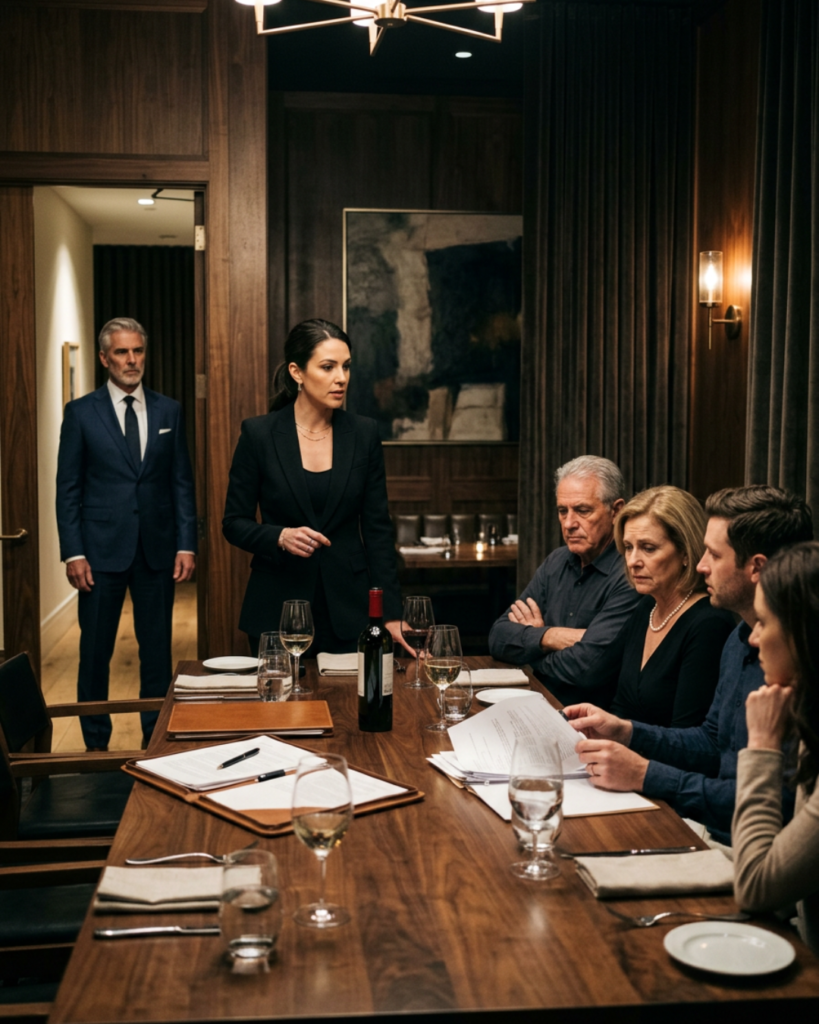
The Private Dining Room Became a Courtroom
We took them to the private dining room at the back, paneled in walnut. It was the room I used for investor dinners and carefully choreographed celebrations. That night it became a courtroom. My father tried for ease and found strain.
“Simple. Tyler is rebuilding. Ren has done very well. We’re asking for a small silent stake so family wealth stays in the family.”
“You’re demanding it,” I said.
“Don’t split hairs.”
Marcus took a seat at the end of the table without waiting to be offered one. He folded his hands. “Let me save time. Dean, you have no standing in this business. Tyler has no standing in this business. Any legal document suggesting otherwise means exactly nothing without Ren’s consent, investor review, and my approval as property owner. Your paper is useless.”
My father’s jaw flexed. “This doesn’t concern you.”
“You made it concern me when you used my name in a threat.”
“Ren, this doesn’t need to become ugly,” my mother said. “We know we weren’t perfect. But punishing your brother forever doesn’t fix anything.”
“You think this is punishment?” I asked. “You all vanished for four years after Dad used my identity to bail Tyler out. Then you walked in here to ask for equity like I owe him a reward.”
Marcus’s attention sharpened. “Identity misuse?”
My father answered too quickly. “That’s a dramatic way to frame family assistance.”
“No,” I said. “That’s the legal way to frame identity misuse.”
Silence fell hard.
Marcus looked at me. “Do you have documentation?”
I had been waiting years for someone to ask that in front of all of them.
The Folder I Had Been Waiting to Open
I opened the leather folder from my office and spread the papers across the table one by one: the original account records, the address match, the payment history, the dispute letters, the credit restoration file, the settlement confirmation. Then, finally, the thing I had found two years earlier and kept in a locked drawer ever since. A photocopy of the intake sheet from the loan office. My signature was forged on the bottom.
“I didn’t press charges because I was twenty-four, exhausted, and trying to survive. That was me being merciful. Don’t mistake it for weakness.”
— Ren, to her father
Something in the room shifted. My father tried to step back into authority but it came out ragged. “This was years ago. We’re not here about that.”
“No,” I said. “You came here because Tyler needs money again. What happened this time?”
Tyler laughed once with no humor. “You wouldn’t understand.”
Marcus answered for them after a pause. “Gaming debt? Or is it tax trouble?”
My father’s temper finally cracked. “You think you know this family? Ren has always been difficult. Suspicious. She twists everything into an accusation. We came to her because family is supposed to help family.”
I had heard versions of that speech my entire life. Harm her first. Then accuse her of cruelty when she bleeds. “Family,” I said quietly, “doesn’t use your credit at nineteen and leave you at twenty-four. Family doesn’t ignore thirty-seven calls. Family doesn’t walk into the thing you built alone and ask what you’re willing to surrender to keep the peace.”
My mother said, “You always made everything harder than it had to be.” That was the closest thing to an apology she was capable of. I felt something in me go completely cold. “Good,” I said. “Then let’s make this easy.”
The Documents
I pulled out my phone and showed Marcus an email thread from my attorney, one from my CPA, and a draft report prepared two years earlier outlining the fraud chronology, the supporting records, and the statute analysis for both civil and criminal options. My father stared. “You built a case against us?”
“I prepared for the day you came back. That’s not the same thing.”
Tyler pushed his chair back and stood up abruptly. Then my father spoke sharply to him to sit down. For the first time that night, I saw real fear in Tyler. It changed his face more than age had. Then, in a panic that made him reckless, he turned on my father.
“You told me she’d never push back. You said she’d still be desperate for us to come back. You told me she’d sign something just to hear you call her family again.”
— Tyler, to their father, in front of everyone
The room went dead silent. The ugly little heart of it, exposed not by me but by him. Marcus stood. “I think that covers motive.”
My father rose too. “You self-righteous little—”
“Careful,” Marcus said. One word, softly spoken, and it stopped him. Dean looked from Marcus to me and realized the room had turned against him completely. Not with drama. Not with shouting. With records. Witnesses. Consequences. The things men like my father hate most. He sat back down.
“What do you want me to sign?” he asked.
Priya brought in the folder my attorney had prepared months earlier. Three documents. The first: a no-contact notice. The second: a written acknowledgment that none of them held any legal or financial interest in Renn. The third: a confessed debt agreement for the original thirty-two thousand dollars plus interest, structured for repayment and enforceable if breached. My father read the first page and laughed bitterly. “You planned all this.”
“You taught me to.”
He looked up at that, and for one long second the years between us collapsed into something simpler and sadder. He had spent my childhood teaching me the world was predatory and that trust without paperwork was stupidity. He just never expected me to apply those lessons to him.
Dean signed first, his pen strokes heavy and angry. Elaine signed next, quiet and pale. Tyler hesitated the longest. “This ruins me,” he said. I looked at him. “No. What ruins you is the belief that somebody else should always pay for what you break.” He signed. At the door, my father turned once as if he wanted to say something that might restore him. What came out was, “You made this public.” I almost laughed. “No. You walked into my restaurant.”
After They Left
They left through the back hall. Service was still going. That, more than anything, felt surreal. I went back to the kitchen. I plated halibut. I adjusted a garnish. I approved a bottle comp for an anniversary couple. At 10:18, I stepped outside into the alley and finally let my body shake.
Marcus joined me a minute later. “You did well.”
“I don’t feel like I did anything well.”
“You held the line. Most people don’t when family uses old wounds as a weapon.”
I laughed weakly. “You know what the worst part is? A tiny part of me still wanted them to walk in here because they missed me.”
Marcus was quiet for a moment. “That part is not weakness either.”
By midnight the dining room was empty. I went to table 7 and stood there alone. The wine glasses had been cleared. The linens were stripped. I put my palm flat against the wood and waited for some cinematic feeling of victory. What came instead was grief. Not because I had lost them that night. I had lost them years earlier, probably long before I admitted it. The grief was for the version of me who spent so long trying to earn tenderness from people who only offered terms.
There are people who think blood should excuse almost anything. Maybe they’ve never been used by the people who taught them what love was supposed to look like. I only know this: when my family came back, they did not come with regret. They came with paperwork. They came with appetite. They came because they believed I was still the daughter they could frighten into surrender. They were wrong.
What I Learned
Boundaries are not cruelty. They are the architecture that keeps the rest of your life standing. If someone tries to make you feel guilty for protecting what you built, ask yourself whether they were ever uncomfortable by what they took from you. If the answer is no, then your silence is not peace. It is only a loan they never intend to repay.
Family is not a license to harm. And forgiveness is not a debt owed to people who refuse to acknowledge what they broke.
If this story resonated with you, share it with someone who needs to hear that protecting yourself is not the same as hurting the people who never protected you.
Practical Advice
If a family member has ever committed financial fraud against you — using your name, your credit, or your personal financial details — you are not obligated to absorb it silently to preserve the relationship. Pull your credit reports regularly. If you find accounts you didn’t open, dispute them immediately and document everything: the original records, the correspondence, the resolution. Keep that documentation permanently. Family members who commit financial fraud once rarely stop, and the second time they usually come with a story about why you owe them. The paperwork you keep today is the boundary you can enforce tomorrow.