I MOVED FROM BOSTON TO QUIET COASTAL MAINE FOR A DRAMA-FREE RESET—NO DEBT, NO CHAOS, JUST ME, MY SPREADSHEETS, AND A ONE-BEDROOM OVERLOOKING THE ANDROSCOGGIN. THEN MY PHONE RANG AT 8 A.M. AND A BANKER SAID, “MS. CLARK, YOUR $500,000 MORTGAGE IS OVERDUE.” I LAUGHED—UNTIL SHE READ MY FULL SOCIAL SECURITY NUMBER AND THE ADDRESS OF A CAPE ELIZABETH BEACH HOUSE I’VE NEVER SET FOOT IN. THE LOAN PDF HIT MY INBOX THAT AFTERNOON… AND THERE WAS “MY” SIGNATURE, PERFECTLY PRACTICED—EXCEPT THE ONE TINY HESITATION MY HAND ALWAYS MAKES WAS GONE. THAT’S WHEN I REMEMBERED MY SISTER’S ‘DREAM COTTAGE’… AND MY MOM’S FAVORITE LINE: “FAMILY ALWAYS DOES.” SO I DROVE TO SUNDAY DINNER, SLID THE PAPERS ONTO THE TABLE, AND ASKED ONE QUESTION… AND MY MOM JUST SMILED AND SAID—
They showed up at my booth like they were approaching a shoreline they weren’t sure would hold their weight.
It was a bright spring Saturday in Brunswick, the kind of day Maine gives you as an apology for winter. The air smelled like salt and thawed earth and lilacs just beginning to try. I’d spent the morning arranging my paintings in neat rows—lighthouses and stormwater and pale skies that looked like they were deciding whether to break or bless you. My little folding table sat near the edge of the artisan fair lot, close enough to hear the river if you stopped and listened, far enough from the food trucks that grease wouldn’t drift over my work.
I was adjusting the price tags when I felt it—the old, familiar sensation of being watched.
Not the casual glance shoppers give when they’re deciding if they can afford something. This was heavier. Charged. The kind of attention that pulls your spine straight before you understand why.
I looked up.
And there they were.
My mother, my father, and my sister.
Standing at the edge of the lot like they didn’t know whether they were allowed to come closer.
My mother clutched her purse the way she used to clutch her Bible at church. My father’s flannel was rumpled, his hair more gray than I remembered. And Tessa—Tessa’s face was bare. No makeup to hide the bruised shadows under her eyes, no glossy curls, no theatrical smile. She looked smaller, like the world had finally taken her measurements and stopped pretending she was exempt.
They didn’t wave. They didn’t call my name. They just stood there, watching me like I was a door they were afraid might slam.
And for a second, the fair noise—the chatter, the laughter, the hum of families walking by with iced coffees and toddlers—faded into something distant. My heartbeat became the loudest sound I could hear.
Because I knew why they were here.
I just didn’t know yet how much I would feel when they said it out loud.
My name is Violet Clark. I’m thirty-two. I’m an accountant in Brunswick, Maine, where quiet streets and salty air feel like a reward after years of grinding in Boston. I moved here for a fresh start. I traded sirens and crowded sidewalks for a small apartment with creaky floors and a view of the Androscoggin River that makes you believe in the idea of beginning again.
My life is simple by design.
No debt. No drama. No people who call only when they need something.
Just me, my spreadsheets, and a coffee pot that’s always on.
But simplicity is fragile when your name isn’t yours.
And three months ago, everything I’d built cracked open with one phone call.
It was a Tuesday. The kind where I was still half-asleep at my desk, hair twisted into a quick knot, sweater sleeves shoved up to my elbows because the office heater never quite got the memo that spring had arrived. I had a stack of client invoices to reconcile and a lukewarm mug of coffee beside my keyboard.
My phone buzzed.
Unknown number. No caller ID, just a Maine area code.
I almost ignored it. I almost let it ring until it stopped, because I’d trained myself to distrust unknown numbers. Unknown numbers lead to sales pitches and scams and people trying to pull you back into old versions of yourself.
But something nudged me to pick up. A small instinct that didn’t feel like paranoia. It felt like a warning.
“Hello?” I said.
“Is this Violet Clark?” The voice was crisp, professional, the kind of voice that reads from scripts and smiles while doing it.
“This is Karen with Coastal Trust Bank,” she continued. “We’re calling about your mortgage balance of five hundred thousand dollars. We’ve sent notices, but your account is overdue.”
For a moment, my brain didn’t translate the words. Mortgage. Overdue. Five hundred thousand. Those were numbers that belonged to someone else’s life—someone with a Cape Elizabeth beach house and a driveway and a reason to own property instead of a rental apartment with a temperamental radiator.
“I don’t have a mortgage,” I said. My voice came out smaller than I intended, like my body didn’t trust it to be loud. “I think you’ve got the wrong person.”
There was a pause. I could hear faint tapping, keys clicking, Karen checking something on her end.
“Ma’am,” she said slowly, and her tone shifted from script to caution. “Our records show your name, date of birth, and social security number. You’re listed as the primary borrower on a loan opened three years ago for a property in Cape Elizabeth.”
The office around me kept moving—printers humming, a coworker laughing softly at something on her screen, the faint smell of someone’s microwave oatmeal drifting from the break room—but I felt like I’d been shoved into a quiet room and locked in.
Three years ago.
My mind jolted back without permission.
Three years ago was when my sister Tessa started obsessing over a beachfront cottage.
A “fresh start,” she called it, after her modeling dreams crashed in New York. She’d come home angry and bright-eyed, telling stories about agents who didn’t call back and casting directors who “didn’t see her,” like the universe had made a clerical error by not worshiping her.
She’d show up to family dinners with her phone, scrolling through Zillow listings, gushing about wraparound porches and ocean views.
“This one,” she’d say, shoving the screen toward us. “Look at the light in the kitchen. It’s perfect.”
My mother would nod along like she was already decorating it. “We’ll make it work, Tessa,” she’d say. “Family always does.”
Family always does.
Those words used to sound like comfort.
Now they sounded like a threat.
I ended the call politely because that’s what accountants do when their world is burning. We keep our voices even because we believe professionalism is a life jacket.
“Can you send me the loan information?” I managed.
“Of course,” Karen said. “We can email the documents to the address on file.”
“What address is on file?” I asked, and my heart began to pound.
Karen read it out. It wasn’t my apartment in Brunswick. It wasn’t even my old Boston address.
It was my parents’ house in Portland.
The call ended, and I sat there staring at my desk as if it might start making sense if I stared hard enough. The hum of the heater suddenly felt too loud. The fluorescent lights felt harsh. My hands were shaking.
I don’t own property. I rent a one-bedroom with creaky floors and a view that’s only beautiful because the river doesn’t care who I am. My finances are tight by design. Every penny accounted for. I keep lists and budgets the way some people keep prayer journals—because organization is the only religion that has never betrayed me.
But five hundred thousand dollars?
That kind of debt doesn’t just ruin a year. It ruins your life.
I told myself it had to be a glitch. A mix-up. Someone with the same name. Someone with a similar social security number—except that doesn’t happen. Not really. Not the way movies suggest. Not with a bank voice on the phone reading my information like she’d rehearsed it.
My gut churned.
Because my family had always treated my identity like a tool.
I’d given them pieces of myself over the years without realizing how dangerous that generosity was.
My social security number “for tax forms.” My signature “for insurance paperwork.” My credit “just this once, Violet, we’ll pay it back.” I’d co-signed medical forms, helped sort debts, wrote checks I couldn’t afford because if I didn’t, the whole house would tilt.
I was the steady one. The one who fixed things. The one who kept the lights on when Dad forgot. The one who kept Mom calm when Tessa’s latest crisis swallowed the room.
Growing up in Portland, I was the kid who balanced the family checkbook because my father’s fishing boat business tanked and no one knew what to do except panic. I was the kid who learned early that if you wanted peace, you became useful.
And now the number on the phone—$500,000—felt like the final proof that being useful had always been the trap.
I left work early, told my manager I had a headache, and drove home through a late-winter drizzle that made the streets look like they were sweating. My apartment felt too small as soon as I stepped inside. The radiator clanged. The river outside moved indifferent and gray.
I tore through the place like I was searching for a missing child.
Under my bed, I had an old storage box where I kept papers I couldn’t bring myself to throw away—tax returns, bank statements, old leases, medical forms. I dragged it out, dumped it on the floor, and sat among the scattered documents like someone trying to build a map out of shredded paper.
There were forms I remembered signing—Tessa’s emergency room visit after she’d totaled her car and called sobbing because she didn’t have insurance. Dad’s boat loan paperwork I’d “helped organize.” A hospital authorization form for Mom from when she’d had her gallbladder removed and needed someone to “handle billing.”
My name was everywhere.
My details.
My trust.
I sat on the floor until my coffee went cold and my legs went numb, staring at a tax form I’d helped Mom file years ago. My social security number was there, written in her looping handwriting. Next to it, a note in the margin.
Violet’s info for backup.
Backup.
That’s what I was to them.
Not a daughter. Not a sister.
A backup plan.
That night, I didn’t sleep.
I lay in bed staring at the ceiling, streetlight glow cutting pale bars through my blinds. Every time I closed my eyes, I saw Tessa at those dinners, laugh too loud, dreams too big, her phone glowing with beach house listings.
“I just need a place to start over,” she’d said, showing Mom a cottage with blue shutters. “It’s perfect for me. Maybe even a family someday.”
Mom had squeezed her hand, promising, “We’ll figure it out.”
I’d smiled then, thinking it was just talk.
Now those words felt like a script.
And I was the one left out of the plot.
By morning, I was back at my kitchen table, hair unwashed, eyes gritty. I’d always been the organized one. The kid who made sure Tessa got to school on time. The one who covered her chores when she forgot. Mom used to call me her “steady hand” like it was a compliment.
I didn’t realize it was a job description.
I opened my laptop and pulled my credit report.
My heart pounded so hard it made my ears ring as the page loaded.
There it was.
A $500,000 mortgage with Coastal Trust Bank tied to a property I’d never seen.
Late payments.
Overdue notices.
A credit score that looked bruised—like someone had punched it repeatedly and expected it to heal on its own.
The report felt like an autopsy.
I found an old envelope from Coastal Trust in the junk mail pile I’d tossed months ago—one of those “pre-approved” offers banks send like bait. I’d thrown it out without reading because I don’t do debt for fun.
Now it felt like a flare I’d ignored.
I called the bank again and requested the loan documents. The clerk promised to email them by the end of the day.
Waiting felt like holding my breath underwater.
When the PDF arrived, I stared at the attachment for a full minute before clicking. My finger hovered like the act of opening it would make everything real.
Then I clicked.
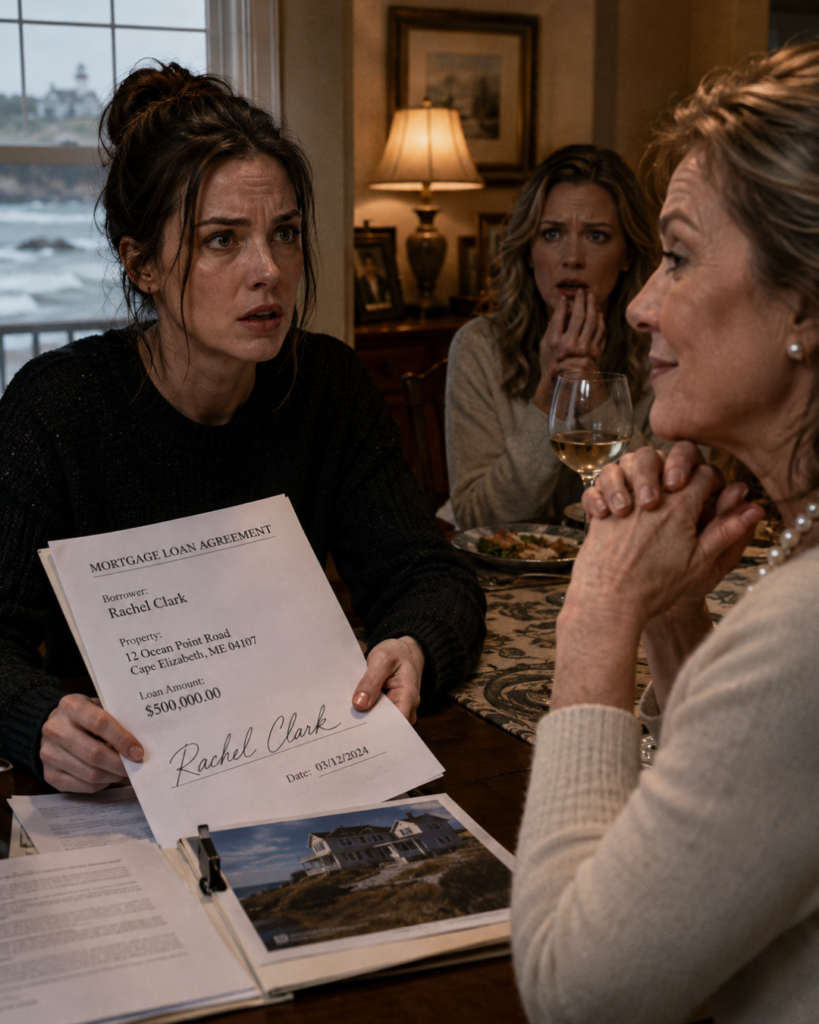
Page one: my name, my birthdate, my social security number.
Page two: the property address in Cape Elizabeth. A cottage near the water—coastal, expensive, everything Tessa used to daydream about.
Page three: a signature.
It looked like mine at first glance.
Same loops.
Same slant.
But it wasn’t.
The L in Violet was too smooth. The R in Clark too sharp. I always hesitate on my Rs—a stupid little quirk from years of signing too fast, a tiny wobble where my hand catches up to my brain. This signature was practiced. Deliberate. Like someone had studied me.
My chest tightened. Heat crawled up my throat.
I wanted to believe it was coincidence.
But the truth was staring back.
My family had done this.
They took my name, my future, and signed it away for Tessa’s dream house.
And I had made it easy by trusting them with every piece of me.
The next day at work, I couldn’t focus.
Numbers blurred on my screen. My hands shook as I held my coffee. Every time someone said the word “loan” in conversation, my stomach clenched.
I kept thinking about all the times I’d said yes.
Yes to co-signing Dad’s loan when his boat engine failed.
Yes to helping Tessa with her credit card debt because “it’s just a rough patch.”
Yes to Mom’s endless paperwork requests because she’d sigh and say, “You’re so good at this stuff, Violet.”
I’d given them my trust because that’s what family does, right?
But now I felt like a vault they’d cracked open.
I needed someone outside the gravitational pull of my family. Someone whose opinion wasn’t tangled in history.
That’s when I turned to Marcy.
Marcy was my coworker—the kind of person who brought donuts on Fridays and actually listened when you talked. She sat across from me in the break room that day, watching me stir my coffee with a trembling hand.
“Violet,” she said softly, her Vermont accent smoothing her words, “you look like you’re carrying the world.”
I meant to say I was fine. I meant to make a joke. I meant to keep my mask.
Instead, I opened my mouth and everything spilled out.
The call.
The mortgage.
The forged signature.
The Cape Elizabeth house.
Marcy didn’t interrupt. She didn’t gasp. She didn’t do the polite, horrified thing people do when they want to step away without looking cruel. She just nodded, eyes steady, absorbing my story like it mattered.
When I finished, she slid her phone across the table.
“Call Jack Brennan,” she said. “He’s a lawyer. Lives in Freeport. He helped my cousin when her ex tried to hide assets in a messy divorce. He’s good with family messes.”
Jack Brennan’s office was a small clapboard building off Route 1. No receptionist. Just a desk piled with folders and a coffee maker that looked older than me. Jack was in his fifties, buzz cut, eyes tired in the way people’s eyes get when they’ve seen too many lies.
He listened without softening.
I handed him my stack of evidence—credit report, bank letters, the mortgage PDF. He flipped through it silently, pen tapping the desk like he was counting seconds.
“This is identity theft,” he said finally, leaning back. “Your family used your information to secure a loan you didn’t consent to.”
My throat tightened. Hearing it said plainly made the situation feel sharper, more real.
“We can dispute it,” Jack continued. “File a police report. Notify the bank in writing. Freeze your credit. Press charges if it comes to that.”
He paused, watching my face.
“It’s not quick,” he added. “And it’ll hurt.”
“Hurt who?” I asked, voice barely above a whisper.
“You,” Jack said simply. “And the dynamic. But you’re not the one who broke it, Violet. You’re just the one cleaning it up.”
That sentence landed like a hand on my shoulder.
Back home, I spent hours digging through old files—forms I’d signed, paperwork I’d helped “organize,” anything that showed how easily my information had been in their hands. Tessa’s school loan forms. Mom’s medical authorizations. A car lease I’d co-signed for Dad.
Each document felt like a brick in a wall I hadn’t seen them building.
By midnight, I had a folder thick with proof.
My life reduced to paper.
But for the first time in days, I felt something other than panic.
I felt like I was holding the reins.
Sunday dinner at my parents’ house in Portland had been a ritual I rarely missed before I moved to Maine. The drive from Brunswick wasn’t long, but that day it felt like crossing into enemy territory. My hands were steady on the wheel, but my stomach was a knot.
The house smelled the same as always—fresh bread, pipe tobacco, the faint sweetness of the candle Mom always lit before guests arrived as if scent could cover sins. Dad sat in his recliner, eyes on a Patriots game. Mom set the table with her usual chatter about neighbors and weather. Tessa sprawled on the couch scrolling her phone like she had no weight to carry.
It was so normal it hurt.
We ate in near silence. Roast chicken, mashed potatoes, green beans with lemon. I waited until plates were cleared, heart pounding but face calm.
Then I folded my napkin and said, “Does anyone know about a mortgage in my name?”
The room froze.
Tessa’s fork clinked against her plate.
Mom’s smile faltered.
Dad shifted in his chair, clearing his throat.
“Coastal Trust,” I continued, voice steady. “Five hundred thousand. For a house in Cape Elizabeth.”
For a second, no one spoke. The silence was thick and telling.
Mom broke first, her voice suddenly soft, the tone she used when she wanted to soothe someone into compliance.
“Oh, Violet,” she said. “It’s just paperwork.”
I stared at her.
“Tessa needed a little help to qualify,” Mom continued, as if she were explaining a harmless misunderstanding. “You weren’t using your credit. And it’s not like you’re paying it.”
Tessa nodded without meeting my eyes. “You’ve got perfect credit, Violet,” she said quickly. “I don’t. It’s not fair if you won’t help your sister.”
Dad said nothing. He stared at the table like wood grain held answers.
My throat tightened—not with tears, but with something sharper.
They didn’t even blink.
To them, it was nothing.
A favor.
A family workaround.
I’d spent years being their safety net, and they thought I’d just nod and accept the weight.
“Thanks for explaining,” I said quietly.
Tessa relaxed, thinking it was over. Mom patted my hand like she’d smoothed everything out.
They didn’t see the shift inside me.
The moment I stopped being their steady hand.
I left without another word, the folder still in my purse, heavier than ever.
Monday morning, I called in sick and drove to the Brunswick Police Station.
The officer who took my report had tired eyes and a clipboard, the look of someone who’d heard a thousand bad stories and didn’t have the luxury of being shocked. He listened as I laid out the facts. I handed him my folder—credit report, bank documents, signatures, dates.
He flipped through it, brow furrowing.
“You sure about this?” he asked carefully. “This is… family.”
I nodded.
“If I don’t,” I said, voice steady, “they’ll do it again.”
He stamped the report. The sound of the stamp hitting paper was small, but in my body it felt like a gavel.
Next, I drafted a letter to Coastal Trust attaching the police report and copies of my ID. Jack Brennan helped me phrase it so it was clean and precise—no emotional language, no pleading, just facts and documentation.
I walked to the post office and watched the clerk slide the envelope into the outgoing tray.
It was just paper.
But to me it felt like a line in the sand.
I didn’t call my family. I didn’t warn Tessa. I didn’t give Mom the chance to cry her way into a narrative where she was the victim.
I let silence do its work.
Days passed. Three. Then five. Then a week.
My phone stayed quiet.
No texts. No voicemails.
The waiting was heavy, but it was mine.
Then one evening, Coastal Trust emailed me.
The mortgage was suspended pending investigation. They’d flagged the signature as questionable. They were reviewing the notary records.
My credit score was still bruised, but the unraveling had started.
I called Jack.
“They’re taking it seriously,” I said.
He chuckled, low and dry. “They usually do when you show up with the truth instead of a fight.”
For the first time in weeks, I smiled.
Not because I was winning.
Because I wasn’t begging.
A week later, I was cooking dinner in my apartment—pasta, jar sauce, nothing fancy—when someone knocked.
Through the peephole, I saw my mother. Diane Clark. Goodwill coat, hair set, face tight like she’d practiced disappointment in the mirror.
I opened the door but didn’t invite her in.
“How could you?” she said immediately, voice sharp but trembling. “Going to the police? Violet, we’re your family.”
I stood there with my arms crossed, feeling the weight of her words without buckling under them.
“You trusted us,” she went on, stepping closer as if closeness could rewrite boundaries. “Tessa just needed help.”
“You stole,” I said calmly.
Mom’s eyes widened like she hadn’t expected me to use that word.
“You’re making us look like criminals,” she hissed.
I held her gaze. “You made yourselves criminals.”
Her mouth opened, then shut. She stared at me as if she’d never really seen me before. Maybe she hadn’t. Maybe I’d always been the steady one, the fixer, the quiet daughter who swallowed resentment and called it love.
“You’re tearing us apart,” she whispered, voice breaking. “Do you know what this could do to Tessa?”
I wanted to laugh, but it caught in my throat.
“I didn’t hear anything,” I said quietly. “I just stopped pretending it was whole.”
Mom’s face hardened. She looked past me into my apartment—the simple furniture, the easel by the couch, the shells on the windowsill. She saw a life she didn’t control.
And for a moment, I saw something in her eyes that wasn’t anger.
It was fear.
She left without another word, heels clicking down the hallway like punctuation.
That night, Tessa blew up my phone.
Ten texts. Three voicemails. Anger, pleading, anger again.
You’re ruining my life.
How could you do this to me?
Mom’s crying because of you.
You always think you’re better than us.
I deleted them without replying.
I wasn’t angry anymore.
I was done.
Done being the one who fixed their messes.
Done being the backup plan in someone else’s story.
That night, when I lay in bed, the silence didn’t feel heavy.
It felt light.
Like the first deep breath after a storm.
Weeks turned into months, and the silence grew softer—less like a wound and more like a choice. I started filling my weekends with things I’d forgotten I loved.
I signed up for a painting class at the community center. My hands got messy with watercolors, creating lighthouses and stormy seas, learning how to let imperfection exist without punishing it. I volunteered with a group preserving Maine’s old lighthouses—cleaning lantern glass, cataloging artifacts, listening to old stories told by people who didn’t need me to be useful to love me.
My credit slowly healed. Coastal Trust’s investigation moved forward. Jack kept me updated—quiet emails, straightforward language. The notary who’d stamped the mortgage had been flagged for “oversight.” That was the polite word for negligence, for letting fraud slide because paperwork moved fast and no one wanted to slow it down.
I checked my credit report like a ritual, watching numbers creep upward, watching late-payment marks begin to shift as disputes were processed.
One weekend, I set up a booth at a Brunswick artisan fair—my first time selling my paintings publicly. My table was lined with waves and skies and one piece I called Anchor. It wasn’t perfect, but it was steady.
A woman stopped and stared at it for a long time. She traced the brushstrokes with her eyes, not her fingers.
“It feels like it’s been through something,” she said softly.
I nodded.
I didn’t explain. I didn’t need to.
My apartment started feeling like home in a way it never had before. Not because it was bigger or nicer. Because it was mine. I put jars of shells on the windowsill. I bought a new easel. I sat on my balcony with tea watching the river, feeling the quiet not as absence, but as space—space to be Violet, not the Clark family’s backup plan.
Then the spring fair came.
The morning I opened this story with.
My family stood at the edge of the lot, looking smaller, like the weight of their choices had finally caught up.
I stepped out from behind my booth, my hands steady.
My mother spoke first, voice shaky, trying to reassemble authority from scraps.
“Violet,” she said, “we messed up. But we’re still family. Don’t shut us out.”
Tessa stepped forward, eyes pleading, voice thin.
“I just need a little help,” she whispered. “Just for now. Please.”
Dad didn’t say anything. He stared at the ground as if it could swallow him.
I let their words hang in the air. I felt the pull of old habits—the reflex to fix, to soothe, to take responsibility for problems I didn’t create.
But I wasn’t that Violet anymore.
I reached into my bag and pulled out a manila envelope.
Inside was the mortgage document stamped VOID in red—Coastal Trust’s final determination—and a faded photograph from when I was ten, helping Tessa build a sandcastle at Old Orchard Beach. Her hair in pigtails, my hands covered in wet sand, both of us laughing like the world was safe.
I’d carried that photo for years because it reminded me of when I believed family meant sacrifice.
I handed the envelope to my mother.
Her hands trembled as she took it.
“I’m not angry,” I said, voice clear. “But I’m not your safety net anymore.”
Mom’s lips parted. She looked like she wanted to argue, to guilt, to pull out the old scripts.
I didn’t give her space.
“Family asks,” I said. “They don’t steal.”
Tessa’s eyes filled with tears. Dad finally looked up, face drawn.
“We can make it right,” Mom whispered.
I shook my head gently.
“I hope you figure out what family really means,” I said. “But I’m done waiting for you to learn.”
Then I turned and walked back to my booth.
I didn’t look back.
The crowd buzzed around me. The air was sharp with salt and spring blooms. A child ran past holding a sticky lemonade, laughing. Someone at the next booth called out a friendly greeting to a customer.
Life moved on the way it always does—indifferent to family drama, loyal only to forward motion.
I rearranged my paintings, straightened the Anchor piece, and felt something settle in my chest.
Not revenge.
Not triumph.
Freedom.
Not just from them.
From the version of me who thought love meant saying yes to everyone who took.
From the version of me who believed being “steady” meant being available for collapse.
I looked out toward the river beyond the fair lot, sunlight glinting off the water like a quiet promise.
For the first time in a long time, the quiet didn’t feel like loneliness.
It felt like room to breathe.