🥂 Where I Started
My name is Margaret.
Russell and I lived in Nashville, Tennessee, where he had spent forty years building a real estate portfolio that made his family name something people recognized at charity dinners and city council meetings.
I was fifty-one when we married. He was seventy-four.
I had worked events at a catering company for eight years before we met — passing champagne trays at the kinds of gatherings I could never afford to attend — and I want to say that plainly, because everything that came after depends on understanding exactly where I started.
I did not marry Russell for love. I want to be honest about that, even now, even here.
He was kind and he was lonely and he made me feel like my company was worth something at a time in my life when I wasn’t sure it was. We were honest with each other in the way two adults who have already survived most of life’s harder lessons tend to be.
And somewhere in the six years that followed — in the ordinary mornings and the quiet dinners and the small unremarkable kindnesses that build a life between two people — I grew into something I hadn’t planned on.
Something real.
But I didn’t know how to name it. And I never told him.
🕯️ The Family Who Was Waiting
His children — a daughter named Diane and a son named Craig — had decided what I was before we’d finished our first conversation.
They were polite about it, mostly. Carefully, expensively polite. The kind of polite that is indistinguishable from contempt if you know what to listen for.
They assumed I was temporary. They assumed I was waiting. They waited too, in their own way — for Russell to come to his senses, for the marriage to dissolve, for things to return to an order they could control.
Russell was no longer with us on a Tuesday morning in February — quietly, in the house we had shared for six years. I sat with him until the end.
Neither Diane nor Craig arrived in time.
⚖️ The Attorney’s Office
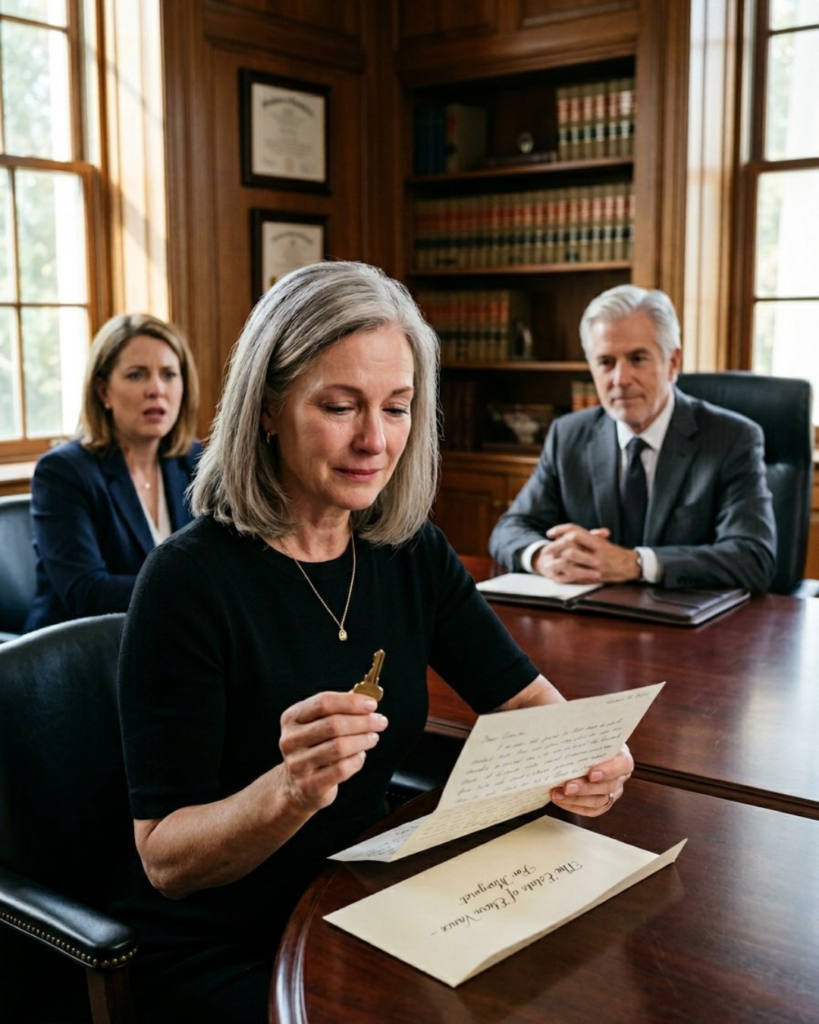
Three days after the funeral, I sat across from both of them in the office of Russell’s attorney — a careful, unhurried man named Mr. Calloway — wearing the same black dress I had worn to the burial because I hadn’t thought to bring anything else.
I told myself I wasn’t expecting anything. I told myself that whatever was in the documents didn’t change what the six years had been. I had my hands folded in my lap and I was doing a reasonable job of believing all of it.
Then Mr. Calloway reached into his drawer and placed two things on the table in front of me.
A small brass key.
And an envelope with my name written on the front.
My throat closed before I even touched it. Because I knew that handwriting. I had watched it fill birthday cards and grocery lists and little notes left on the kitchen counter for no reason except that Russell had thought of something he wanted me to know.
I picked up the envelope. I unfolded the letter inside. And I began to read.
📜 The Letter
“If you are reading this, then I am gone. And if you are reading it, then you are probably confused about why there is no fortune waiting for you. Everyone will expect me to leave you money. My children will expect it. You may even expect it, even if you never admitted that to yourself. But I did not marry you to make you rich. And I did not keep you in my life because I was lonely.”
Across the table, Diane shifted in her chair. Craig glanced at his watch. The lawyer sat perfectly still.
I kept reading.
Russell wrote that he had not been blind. That he had seen everything — the visits that only came when something was needed, the phone calls that dried up the moment he said no, the way affection disappeared from his children’s voices whenever he declined a request.
He wrote that wealth had a way of replacing the people around you with performances of people, until you couldn’t remember what genuine company felt like.
And then he wrote the line that made my vision blur:
“I kept you in my life because you were the only person who treated me like I was still alive. Not just wealthy.”
I had to stop reading for a moment. I thought about all the ordinary evenings that one sentence contained. The way he asked about my day and then actually waited for the answer. The way he never once made me feel small for where I had come from. The way he sat with me in the kitchen at midnight sometimes for no reason except that neither of us could sleep and that felt like enough of a reason.
I kept reading.
💢 “This Is Ridiculous”
“This is ridiculous,” Diane said.
Mr. Calloway raised one finger. She went silent.
I kept my eyes on the page.
Russell wrote that I hadn’t loved him perfectly — and that he had known that from the beginning. But I had loved him honestly. And in the end, honesty was the rarer and more valuable thing.
Then the letter shifted, and something in the room changed even though nothing moved.
He wrote about the key. About a safety deposit box. He wrote that everything he had built before me — the properties, the accounts, the decades of accumulated wealth — would go to his children. They already had enough.
But everything he had become after meeting me belonged to me alone.
And in that box I would find something he had never shown anyone. Not his children. Not his business partners. Not his lawyers. Because, he wrote, it was never about money. It was about truth.
The final line read:
“Open it, and you will understand why I said you deserve exactly what you deserve.”
No signature. No goodbye. Just silence on paper.
I folded the letter slowly. I closed my hand around the brass key.
Diane was already on her feet — this is ridiculous, he left her something secret, he must have been manipulated — and Mr. Calloway cut her off with the quiet firmness of a man who had been expecting exactly this reaction.
I didn’t look at her. I was looking at the key in my palm.
Because I had just understood something that changed the shape of everything in that room:
This wasn’t the inheritance. The box wasn’t the ending. Russell had left me a door.
And whatever was behind it, he had spent years making sure it would open at exactly this moment.
🏦 The Vault
Two days later I stood alone in front of a vault at the First National Bank of Nashville.
My hand was steadier than I expected. The branch manager opened the safety deposit box and stepped aside without a word. I took a breath and opened it.
Inside was a thick folder. Medical reports. Bank statements going back more than a decade. Old legal correspondence I didn’t immediately recognize.
And beneath all of it — a second will. Dated years before our marriage. Before me. Before any of this.
I opened it carefully. And I felt my stomach drop.
Because it wasn’t a love letter.
It was a record.
A meticulous, documented account of what his children had been doing for years while Russell sat quietly in his study and watched and wrote it all down.
Requests for early distributions that he had refused — followed by formal legal proceedings initiated to have him declared mentally unfit to manage his own affairs, filed while he was in perfectly good health, simply because he had said no.
Documented instances of grandchildren being withheld from him as leverage.
Affidavits from two longtime employees describing conversations they had overheard.
Every page dated. Every incident cross-referenced. Every piece of it assembled with the careful patience of a man who had decided, years before I ever appeared in his life, that the truth deserved to be preserved.
And at the bottom of the will, a clause written in language that left no room for interpretation:
Any attempt to contest or manipulate the estate after Russell’s passing would result in the immediate and total forfeiture of everything.
I set the folder down on the bank manager’s table and I stood very still for a long moment.
Russell hadn’t just protected his assets. He had protected his story. And he had placed me — the woman everyone assumed was the threat — at the center of it as the one person he trusted to hold the truth.
📞 “They’ve Filed a Legal Challenge”
That evening, Mr. Calloway called. His voice was careful and unsurprised.
“They’ve filed a legal challenge. Undue influence. They’re claiming you pressured him into altering his estate plans.”
I almost laughed. Me. A woman who had passed champagne trays at parties she couldn’t afford to attend, pressuring a man who had owned half the city.
“What do we do?” I asked.
A pause. Then:
“We let Russell speak.”
🏛️ The Courtroom
The courtroom was colder than I expected.
I watched Diane and Craig walk in with their black suits and their rehearsed grief and their absolute certainty, and I remembered the first time I had met them — how they had looked at me across Russell’s dining room table with that particular polished politeness that is indistinguishable from contempt if you’ve ever been on the receiving end of it.
They had always believed I was temporary. They still did.
That confidence filled the room like weather.
Their attorney moved first.
“Your Honor, we believe the deceased was not in a stable state of mind when these documents were altered.”
The word altered landed in the room like a stone into still water.
My attorney stood.
“Then perhaps the court would like to review Exhibit A.”
The screen came down.
And Russell appeared.
📺 “I Am Not Confused”
Alive. Seated at his desk in the study where I had watched him read the newspaper every single morning for six years, in the chair by the window where the light came in sideways in the afternoon.
His voice was calm. Steady. Completely, unmistakably his.
“If you are watching this, then I am gone, and my children are doing exactly what I expected them to do. I am not confused. I am not coerced. I am fully aware of what I am leaving behind. The only person in my life who never tried to take from me was the one everyone assumed was taking.”
I heard Diane draw a sharp breath beside her attorney.
I didn’t look at her. I kept my eyes on the screen and I did not let myself cry, because I had promised myself I wouldn’t — and also because what I was feeling in that moment wasn’t exactly sadness.
It was something stranger and quieter.
It was the feeling of being seen. Fully. Finally. By someone who was no longer there to see it happening.
Russell spoke about his children on that screen — not with anger, because anger wasn’t how he was built — but with the quiet, unsentimental clarity of a man who had watched and waited and documented everything over the course of years.
He described the pressure campaigns. The legal maneuvering. The grandchildren used as leverage. He described feeling, in his later years, like he had become a balance sheet to the people who were supposed to love him.
And then he said:
“My children will argue. They will accuse. They will try to rewrite who I was in my final years. But I built my life long before I had money. And I know exactly who stood by me when I stopped being useful to them.”
The screen went dark.
No one in that courtroom moved for a long moment. Not the attorneys. Not the gallery. Not the judge.
🚪 The Clause
The case didn’t end that day — nothing like this ever does, and there were more hearings and depositions and long afternoons in rooms that smelled of old carpet and whiteboard markers.
But it ended.
The will stood. Entirely. Legally binding. Unbreakable.
Under the clause Russell had buried in the second will, Diane and Craig’s challenge cost them everything they had come to court to protect.
Afterward, on the courthouse steps, Diane found me.
She looked smaller than I had ever seen her — like something essential had been slowly let out of her over the months of the proceedings.
She looked at me for a long moment. Really looked, for the first time since the day we met.
“You didn’t even love him when you married him,” she said.
It wasn’t an accusation. It was exhaustion.
“No,” I said. “I didn’t.”
She let out a short, bitter sound.
“And he still gave you everything that mattered.”
I looked down at the brass key I still carried in my coat pocket. At the folder under my arm. At the life I had never planned to inherit — not in money, but in meaning.
“I think he gave me something else,” I said quietly.
“What?”
I looked up.
“Proof that people can be completely wrong about you — and still not define you.”
She didn’t answer. But she didn’t argue either.
And for the first time since any of it began, that felt like enough.
📬 The Second Letter
A year later, a second letter arrived in my mailbox. Simple envelope. No court seal, no lawyer’s name, no return address. Just my name, in handwriting I recognized before I even carried it inside.
I sat down at the kitchen table — the same table where Russell and I had sat together a thousand unremarkable mornings — and I opened it.
One page.
“If you are reading this, it means you chose peace over possession. That is how I know I was right about you. I was not a rich man because I had money. I was a rich man because I finally met someone who saw me as human again.”
I read it twice. Then I folded it carefully and placed it in the same box as the first one.
🏡 The House on the East Side
I moved to a smaller house on the east side of Nashville — not a symbol of anything, not a statement, just a place that finally felt like mine.
I started working again — not because I had to, but because I had found something I wanted to build.
I worked with women who were starting over after loss and divorce and betrayal — women who had been dismissed and erased and underestimated by people who stood to gain from it.
Every time I sat across from one of them and listened to her story, I recognized something deep and familiar.
I wasn’t the only one who had ever been misread.
I had simply survived mine with the evidence preserved.
🌸 The Cemetery
One afternoon, without planning it, I found myself driving to the cemetery.
I parked and walked to Russell’s grave and stood there for a while as the wind moved through the bare trees overhead.
Then I said, out loud, to no one and to him at the same time:
“You were right. I did understand, eventually.”
A pause.
“And I’m okay now.”
I placed a single flower on the stone. Nothing extravagant. Just simple. Just honest. The way he would have wanted.
🪞 The Reflection
On the drive home, I passed a shop window and caught a glimpse of my own reflection and stopped walking without meaning to.
Not because I looked different.
But because the woman looking back at me was not afraid.
She was simply standing there in the middle of an ordinary afternoon, taking up exactly the space she was allowed to take up — not shrinking from anyone’s assumptions, not defending herself against anyone’s version of her story.
Just standing.
Just present.
Just herself.
I smiled at her.
Not because I had inherited a fortune.
But because I had finally inherited something Russell had understood about me long before I understood it about myself:
That I was worth seeing clearly. And that the people who couldn’t do that were never going to be the ones who got to decide.
💡 Takeaway
The people who profit most from misunderstanding you are rarely the ones who get to write the ending. Wealth doesn’t corrupt people — but it does reveal them. And the truth, when someone loves you enough to protect it, always waits patiently for its moment.
If someone in your life is quietly documenting who you really are — even when the world insists on getting you wrong — that is not a small love. That is the rarest kind.
🗣️ What Would You Have Done?
👉 If you married someone honestly, but without love — and grew into loving them later — would you have told them before they were no longer with you, or held it quietly the way Margaret did?
👉 Have you ever been the “outsider” in a wealthy family, judged before you were ever known? What surprised you most about who actually stood by you when it mattered?
💬 Drop your answer in the comments — and share this story with someone who has been misread for too long by people who profit from misunderstanding them. ❤️
Disclaimer: This story is entirely fictional. Any resemblance to real persons, living or departed, or actual events is purely coincidental. It was written for entertainment and emotional storytelling purposes only.