Trump Warns of 10-Year Prison Sentences Amid Growing Reflecting Pool Controversy
President Donald Trump has issued a stern warning that those responsible for allegedly vandalizing Washington, D.C.’s iconic Reflecting Pool could face prison sentences of up to 10 years, as controversy continues to grow surrounding a costly renovation project that has attracted national attention.
The warning comes as questions mount over the condition of the historic landmark, which recently underwent an extensive restoration effort ordered by the Trump administration. The project, reportedly costing more than $14 million, was intended to revitalize one of the nation’s most recognizable public spaces. Instead, it has become the center of a political and public relations storm.
Located between the Lincoln Memorial and the Washington Monument, the Reflecting Pool has long served as a symbol of American history and democracy. Millions of visitors travel to the National Mall every year to view the landmark, which has appeared in countless photographs, documentaries, and historic events.
The renovation was designed to improve the pool’s appearance and restore its infrastructure. As part of the work, the pool was drained, resurfaced, and repainted. Officials hoped the makeover would preserve the site while creating a cleaner and more visually striking attraction for visitors.
However, reports soon emerged suggesting the project had encountered significant problems.
Within weeks of the renovation’s completion, observers noticed that portions of the newly applied paint appeared to be peeling away. At the same time, sections of the water reportedly began turning green due to algae growth, raising concerns about the effectiveness of the restoration effort.
The unexpected developments quickly sparked criticism online, with commentators questioning both the design choices and the substantial taxpayer expense associated with the project.
Trump Blames Vandals
President Trump has rejected suggestions that the problems stem from construction or maintenance issues. Instead, he has pointed the finger at alleged acts of vandalism.
In a series of public statements, Trump claimed individuals intentionally damaged both the pool and surrounding landscaping.
According to the president, vandals caused extensive damage to newly installed grass areas and may have introduced chemicals into the water in an effort to undermine the renovation.
Trump argued that the damage was part of a deliberate attempt to sabotage what he described as a successful restoration project.
“We’ve had some real problems with vandalism at the beautiful Reflecting Pool,” Trump said while discussing the issue publicly.
The president further alleged that chemicals similar to those used in previous incidents affecting areas of the National Mall had been introduced into the pool, causing damage to the new surface and contributing to the deterioration now visible.
While Trump has been adamant in his claims, critics have noted that no publicly released evidence has yet been presented linking the peeling paint or algae growth directly to acts of vandalism.
A Strong Warning
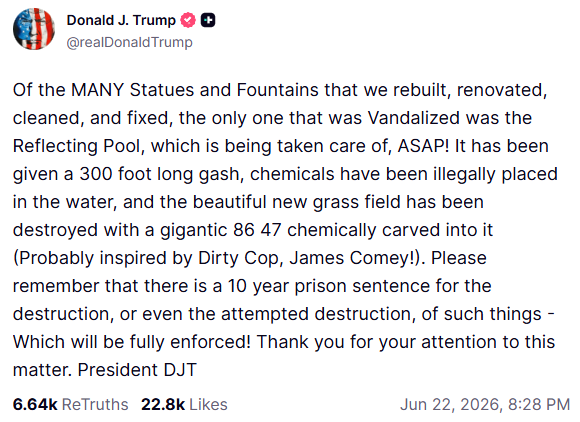
The controversy escalated further when Trump used social media to issue a warning regarding potential legal consequences for anyone found responsible.
The president claimed the Reflecting Pool had suffered a large gash and additional damage to surrounding grounds. He also alleged that chemicals had been used to destroy portions of the newly renovated landscape.
Trump emphasized that federal laws provide severe penalties for damaging government property and stated that authorities would fully enforce those statutes.
The warning included a reminder that individuals convicted of destroying or attempting to destroy certain public monuments, statues, fountains, and federal landmarks could face prison sentences of up to a decade.
The comments immediately attracted widespread attention online, with supporters praising the administration’s tough stance while critics questioned whether the evidence justified such dramatic warnings.
Arrests Add New Twist
The situation became even more complicated after reports emerged that several individuals had been arrested in connection with alleged vandalism incidents near the Reflecting Pool.
Among those arrested was David Hearn, a 67-year-old three-time Olympian whose account of the incident differs significantly from allegations suggesting intentional damage.
According to Hearn, he stopped near the Reflecting Pool during a lengthy bicycle ride and briefly touched the water with his hand.
Speaking about the encounter afterward, Hearn insisted he had not damaged any property and had no intention of interfering with the site.
He stated that he merely wanted to feel the water and was surprised when law enforcement officers approached and arrested him.
“I didn’t destroy or break or peel anything,” Hearn reportedly said while describing the incident.
Despite his denial, Hearn now faces a misdemeanor charge involving destruction of government property. Court records indicate he is scheduled to appear before a judge in Washington, D.C., in the coming weeks.
The case has generated significant discussion because of Hearn’s background as an accomplished athlete and because some observers believe his arrest highlights broader concerns about how authorities are handling the investigation.
Questions Remain Unanswered
As the controversy continues, many key questions remain unresolved.
Federal officials have not publicly released detailed evidence explaining how the alleged vandalism occurred or whether any suspects were directly responsible for the visible deterioration of the Reflecting Pool.
Likewise, experts have pointed out that algae growth can occur naturally under certain environmental conditions, particularly in large outdoor water features exposed to sunlight and changing temperatures.
Similarly, paint failure can result from a variety of factors, including surface preparation issues, material selection, weather exposure, or chemical interactions.
Without additional information from investigators or engineering assessments, it remains difficult to determine the precise causes behind the pool’s current condition.
Political Fallout
The Reflecting Pool dispute has also taken on political dimensions.
Supporters of the administration argue that public landmarks should be protected from vandalism and that strong penalties are necessary to deter future incidents.
Critics, however, contend that the administration may be using vandalism allegations to deflect attention from potential problems associated with the renovation itself.
The debate has fueled broader discussions about government spending, public infrastructure projects, and accountability for taxpayer-funded renovations.
With millions of dollars invested in the restoration effort, many Americans are eager to learn exactly what went wrong and who, if anyone, should be held responsible.
What Happens Next?
For now, crews continue working to address issues affecting the Reflecting Pool while investigators examine allegations of vandalism.
The administration has promised that repairs will be completed quickly and that any individuals found responsible for damaging federal property will face the full consequences of the law.
Meanwhile, the legal proceedings involving those already arrested are expected to draw additional attention in the coming weeks.
As officials attempt to restore one of Washington’s most famous landmarks, the Reflecting Pool remains at the center of a growing controversy involving politics, public spending, law enforcement, and preservation of national treasures.
Whether the damage was caused by vandals, environmental factors, construction issues, or some combination of all three remains a subject of intense debate.
What is certain is that a renovation intended to showcase a revitalized national landmark has instead become one of the most talked-about controversies in the nation’s capital.